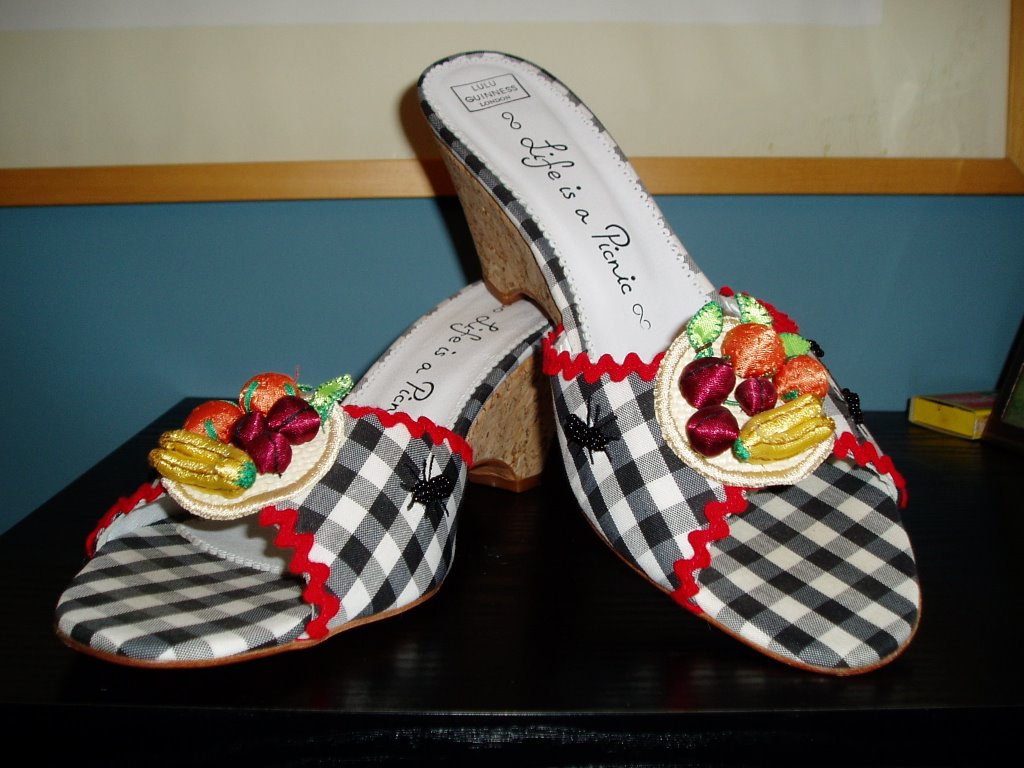
 Someone asked about the shoes on yesterday's post. I got them in the Lulu Guinness sale but I don't wear them - they're too beautiful. Of course I probably should, how daft am I? I can just hear my mother's voice, 'now she's only gone and spent her money on a pair of shoes she won't wear', but instead they sit on a shelf in my office like works of art and make me smile every time I pass them. This 'book bag' I do use, however - it was a present from my husband when I finished my second novel and I definitely felt I deserved it!
Thursday, September 07, 2006
Someone asked about the shoes on yesterday's post. I got them in the Lulu Guinness sale but I don't wear them - they're too beautiful. Of course I probably should, how daft am I? I can just hear my mother's voice, 'now she's only gone and spent her money on a pair of shoes she won't wear', but instead they sit on a shelf in my office like works of art and make me smile every time I pass them. This 'book bag' I do use, however - it was a present from my husband when I finished my second novel and I definitely felt I deserved it!


Wednesday, September 06, 2006
 Life Is A Picnic, or ....
I've been neglecting Poetry Thursday for too long so to reprimand myself, and also because it's 'back to school' week and that always makes me feel industrious, here's To be of use by Marge Piercy from Circles on the Water. (oh ps. hopefully everyone will know Marge Piercy but if not, please look her up. She's a FAB writer - her strange novel Woman on the Edge of Time is probably one of the books that has made the most impression on me ever, as writer, woman, etc etc. In fact I'm persuading myelf to read it again ...)
To be of use
The people I love the best
jump into work head first
without dallying in the shallows
and swim off with sure strokes almost out of sight.
They seem to become natives of that element,
the black sleek heads of seals
bouncing like half-submerged balls.
I love people who harness themselves, an ox to a heavy cart,
who pull like water buffalo, with massive patience,
who strain in the mud and the muck to move things forward,
who do what has to be done, again and again.
I want to be with people who submerge
in the task, who go into the fields to harvest
and work in a row and pass the bags along,
who are not parlor generals and field deserters
but move in a common rhythm
when the food must come in or the fire be put out.
The work of the world is common as mud.
Botched, it smears the hands, crumbles to dust.
But the thing worth doing well done
has a shape that satisfies, clean and evident.
Greek amphoras for wine or oil,
Hopi vases that held corn, are put in museums
but you know they were made to be used.
The pitcher cries for water to carry
and a person for work that is real.
Tuesday, September 05, 2006
In one of my short stories, I make fun of the idea that you might be thinking of someone just at the very moment they're ringing you up. However, I'm ABSOLUTELY delighted to hear that telephone telepathy might just be true. It makes a much better story!
 How important are your roots in your writing? This is a question I've been thinking about for some time now, not least in relation to the whole aspect of making things new. Trouble is, with the best will in the world, the area of England I grew up in isn't very exciting. Even its own website has John Major as the pin up boy and admits that it is normally thought of as 'hardly remarkable'. But is that the case? Surely it's up to me as a writer to make it interesting? This is a challenge I intend to rise to, particularly as I freewrite about all the images and memories that have stuck with me - getting bogged down literally in the bog for several hours in a cold landrover on Christmas day, going to see ALL of the original Planet of the Apes films in the local fleapit, my first kiss outside the youth club, horseracing, the postman we had in the village who couldn't read and so had to ask at each house what letters he should deliver to the next house, cycling along straight windy roads, the smell of sugar beet, the reflected glory we got from having BOTH Samuel Pepys and Oliver Cromwell as 'local lads', and above all the strange relationships and names of the families living around.
The wonderful Laurie Graham, a writer I've just discovered but who must have some Fen blood in her somewhere has tempted me with this last one. Here's an extract from her book, The Future Homemakers of America, about a conversation between an American and a Fenwoman:
"She was Annie Jex, then she married Harold Howgego. Their boy Colin was took prisoner in the last lot; Japs got him. You should have seen him when they sent him home. I've seen more flesh on a sparrow. Now, he married a girl from Lynn, and her mother was a Jex, only not the same lot, of course. Annie as one of the Waplode Jexes, and her mother was a Pargeter."This sent shivers down my spine as it could have so easily been my mother talking when she was trying to explain - as simply as she could - who someone was. It used to send us into gales of laughter - matched only by the time she described a 50 year old man as 'young Arthur'. Actually, I'm not sure now if it was her description or her anger at our laughing about it that made us the happier. Although of course we also got pretty merry with the way a real Fenman we knew used to start every sentence with 'I'll just turn round and ...'
So my writing prompt for today is going to be to try to capture the essence of Huntingdon. There's more food for thought about how our place shapes us here.
Monday, September 04, 2006
There's still time to enter the Arvon International Poetry Competition 2006:
This year marks 25 years of the Arvon Poetry Competition. Over the last quarter of a decade the top prize winners have included Andrew Motion, Selima Hill, Don Paterson, Paul Farley, Mario Petrucci and Joe Kane. All poems are read by the judges and are anonymous, previously unpublished and written in English. Closing date 15 September. First Prize £5000, Second Prize £2500, Third Prize £1000, Three prizes £500 each.
And if you're in need of inspiration, the site has some well-thought through tips from Choman Hardi too.
This year marks 25 years of the Arvon Poetry Competition. Over the last quarter of a decade the top prize winners have included Andrew Motion, Selima Hill, Don Paterson, Paul Farley, Mario Petrucci and Joe Kane. All poems are read by the judges and are anonymous, previously unpublished and written in English. Closing date 15 September. First Prize £5000, Second Prize £2500, Third Prize £1000, Three prizes £500 each.
And if you're in need of inspiration, the site has some well-thought through tips from Choman Hardi too.
Further to Clare's interview with a 'Reader in Residence', a friend's sent me this link to Library Thing where you enter either just the book you're reading or your whole bookshelf (titles of course, not the actual thing) and so get linked with people reading the same thing(s) as you. I love the fact that all the moaners said that the internet would mean the end of books, but - unless I'm being naive - the opposite seems to be the case.
Sunday, September 03, 2006
I recommend you read Clare Dudman's excellent and interesting interview with Susan Tranter, Reader in Residence with the British Council. I particularly liked the idea of Encompassculture, a world wide reading group!
So do I want to be a 'better me'? Always, which is why I've been obsessed with this quiz. I'll believe what I've been telling myself - that it's all a bit of fun - when I get full marks, and at the moment I'm a long way off!!!!
Friday, September 01, 2006
One of the books I've been most looking forward to reading for a time has been Jon McGregor's second novel, So Many Ways To Begin, and this interview with him I dug out of the archives of the Bloomsbury website is a fascinating insight into the collage of places and things that eventually make up a novel.
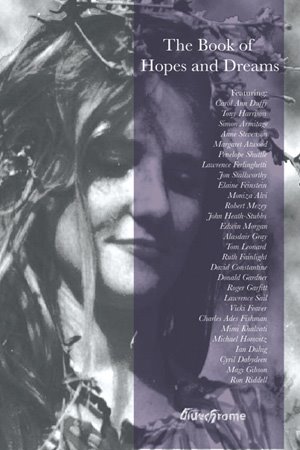 I wish I'd been asked to contribute to this book but I wasn't (sob) so the least I can do is tell you about it and encourage you to get a copy from Bluechrome. The Book of Hopes and Dreams is a collection of poetry from writers such as Simon Armitage, Margaret Atwood, Moniza Alvi, Alan Brownjohn, David Constantine, Cyril Dabydeen, Carol Anne Duffy, Ian Duhig, Ruth Fainlight, Vicki Feaver, Elaine Feinstein, Lawrence Ferlinghetti, Charles Ades Fishman, Magi Gibson, Alasdair Gray, Tony Harrison, John Heath-Stubbs, Michael Horovitz, Mimi Khalvati, Tom Leonard, Robert Mezey, Edwin Morgan, Lawrence Sail, Penelope Shuttle, Jon Stallworthy, Anne Stevenson and many others. As well as its charity element - it is raising money for Spirit Aid - it has a particular aim which is reflected in the book's title, and I quote:
 "The poetry within its covers is subversive; reading it may lift your spirits and could possibly infect you with optimism. Exposure to optimism can be dangerous; it is not just delightful, but highly-addictive. In extreme cases addicts will happily run the risk of public ridicule by swimming against the prevailing tide of post-modern, ironic ennui. Their street-credibility decimated, their cool lost forever; you will know these hapless addicts by the upturning of their lips and the twinkle in their eyes."You can find out more by visiting the website of the editor, Dee Rimbaud.
Thursday, August 31, 2006
Sunday, August 27, 2006
There's a particularly interesting 'life of the day' from the Oxford Dictionary of National Biography today:
Smith, (Lillias Irma) Valerie Arkell- [née Lillias Irma Valerie Barker] (1895-1960), sexual impostor and perjurer, was born on 27 August 1895 in St Clements, Jersey, the daughter of Thomas William Barker (1857-1918), gentleman farmer and architect, and his wife, Lillias Adelaide Hill (1868-1923). Her parents moved to Surrey in 1899, where her brother Tom Leslie was born. Valerie was educated at Huxley's School for Young Ladies at Prior's Corner, Surrey, and then at Upavon, Wiltshire, finishing her education at a convent school at Graty near Brussels.
In 1914 Barker took up war work as a VAD attached to St Hilda's Hospital, Haslemere. From 1915 she worked as a horse trainer for the Canadian army at Rodborough Common and then at the Bristol remount depot. She remained working with horses, moving on to a hunting stable near Shrewsbury and then to a stables in Meopham, Kent. While in Kent, Barker met her first husband, Lieutenant Harold Arkell-Smith (b. 1882/3) of the Australian 20th battalion. They married on 27 April 1918 but the marriage lasted only six weeks, although they never divorced, and she subsequently returned to her parents' house. On 26 August 1918 she enrolled as a member of the Women's Auxiliary Air Force.
After the war Arkell-Smith worked in a tea-shop in Warminster, where she met her next partner, the Australian soldier Ernest Walter Pearce Crouch (1876-1923), who was married but separated. They lived together in Shepperton, and then from July 1919 in France, where he worked in the Paris office of The Times. Their son Tony was born on 27 February 1920 in Paris. Nine months later Pearce Crouch lost his job and they returned to England. On 15 June 1921 their daughter Betty was born. They managed to find work as tenant farmers at Bailiffs Court, an estate in Climping in Sussex. However, their relationship was unsatisfactory and Arkell-Smith spent her time with Elfrida Emma Haward (b. 1895/6), whom she had met in 1922 in Littlehampton. She left Pearce Crouch in 1923 and began a life as a man under the assumed identity of Victor Barker.
Arkell-Smith checked into the Grand Hotel in Brighton as Sir Victor Barker. The transition was easy for she had already gained a reputation for 'affecting masculine attire, and particularly for wearing men's heavy boots' (Daily Mail, 3 March 1929). As Colonel Victor Barker she married Elfrida Haward at St Peter's parish church in Brighton on 14 November 1923. The marriage was conducted by the Revd Laurence Hard, who was apparently unaware of the groom's real identity. 'I told Miss Haward that I was not what she thought I was; I told her that I was a man who had been injured in the war' (Sunday Dispatch, 10 March 1929). Elfrida always maintained that she believed her.
As the 'Colonel', Arkell-Smith followed a variety of careers, including that of an actor with the stage name of Ivor Gauntlett, boxing club manager, owner of a secondhand furniture business, dog kennel manager, dairy farm manager, cafe owner, and orchard worker. Owing to this instability Elfrida left the 'Colonel' in autumn 1928 and returned to her father's house. Arkell-Smith became politically involved with the National Fascisti, a militant breakaway group of Britain's fascist movement, in 1927, running a boxing programme for its members.
In 1929, after Arkell-Smith had changed both her name and rank to Captain Leslie Ivor Victor Gauntlett Bligh Barker, she found work as a desk clerk in the Regent Palace Hotel in London, posing as a retired officer. There she was arrested on a bankruptcy charge and was sent to trial at the Old Bailey in London. Put on remand at Brixton prison, she was found to be a woman. The charges against Arkell-Smith were in consequence increased to include perjury as a result of her marriage to Elfrida Haward.
The trial was sensationalized in the press. The prosecutor, Sir Ernest Wild, revealed that not only had Arkell-Smith married Miss Haward posing as an officer, but she had also been tried as a man two years previously in July 1927 in the Old Bailey for possessing a forged firearm certificate, although found not guilty. With the revelation of the new charges, she was found guilty of perjury and was sentenced to nine months in Holloway prison. Despite her marriage to Elfrida, Arkell-Smith was not charged under the amendments to the 1920 Sexual Offences Act.
When Arkell-Smith left Holloway she reverted to the identity of Victor Barker. After a variety of short-term jobs, calling herself John Hill, by 1937 she was attracting enormous crowds to her show, entitled On a Strange Honeymoon, in Blackpool, where she portrayed Colonel Barker.
Under another male identity, that of Jeffrey Norton, Arkell-Smith lived as the husband of Eva Norton. In the early part of the Second World War she worked as a switchboard operator in a hospital outside London, and also joined the Home Guard. After the war the couple moved to Kessingland, Suffolk, where Arkell-Smith called herself Geoffrey and became a shop assistant. She died of Parkinson's disease on 18 February 1960 at 3 Wrights Cottages, London Road, Kessingland, Suffolk, and was buried in the grounds of St Edmund's Church, Kessingland, on 23 February. On her death certificate her name was given as Geoffrey Norton, otherwise Lilias Irma Valerie Arkell-Smith.
Emma Milliken
Saturday, August 26, 2006
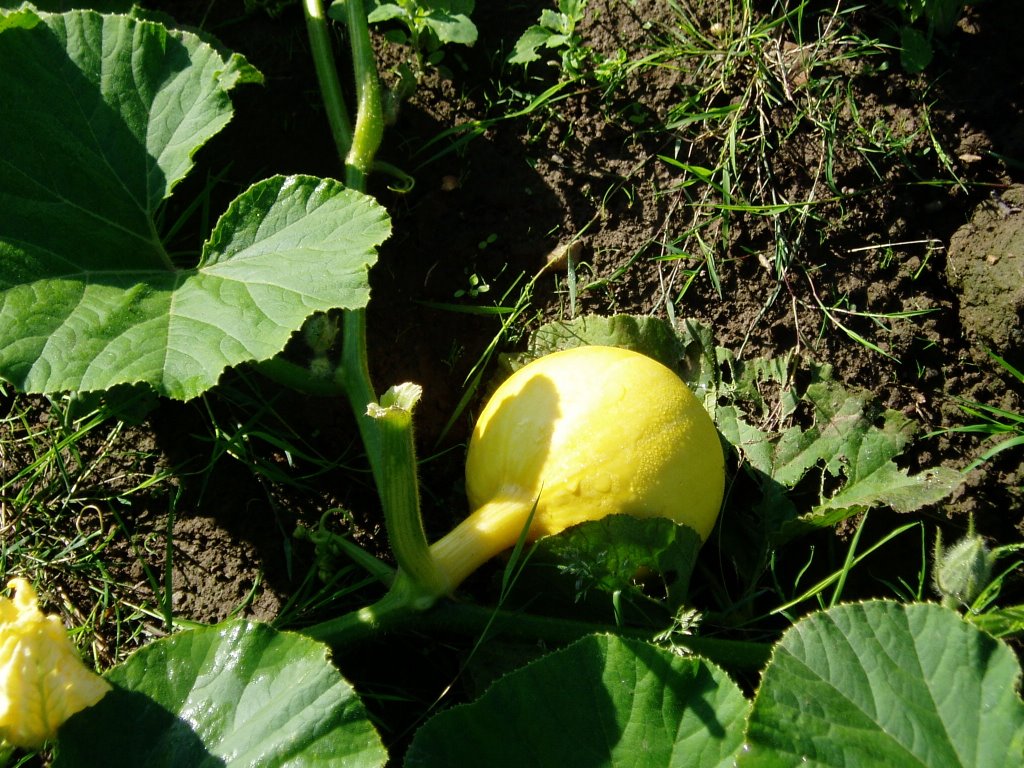
Well, this is all very disappointing. With only two weeks to go to the great allotment show, my hopes of becoming the Nigella of the Giant Pumpkin world are being cruelly dashed. Even I will admit that my entry to the Heaviest Pumpkin category is looking slightly weedy:

especially compared with those of the past (I've tried making this photo smaller to make them look less impressive but it still doesn't work! These are BEASTS!):

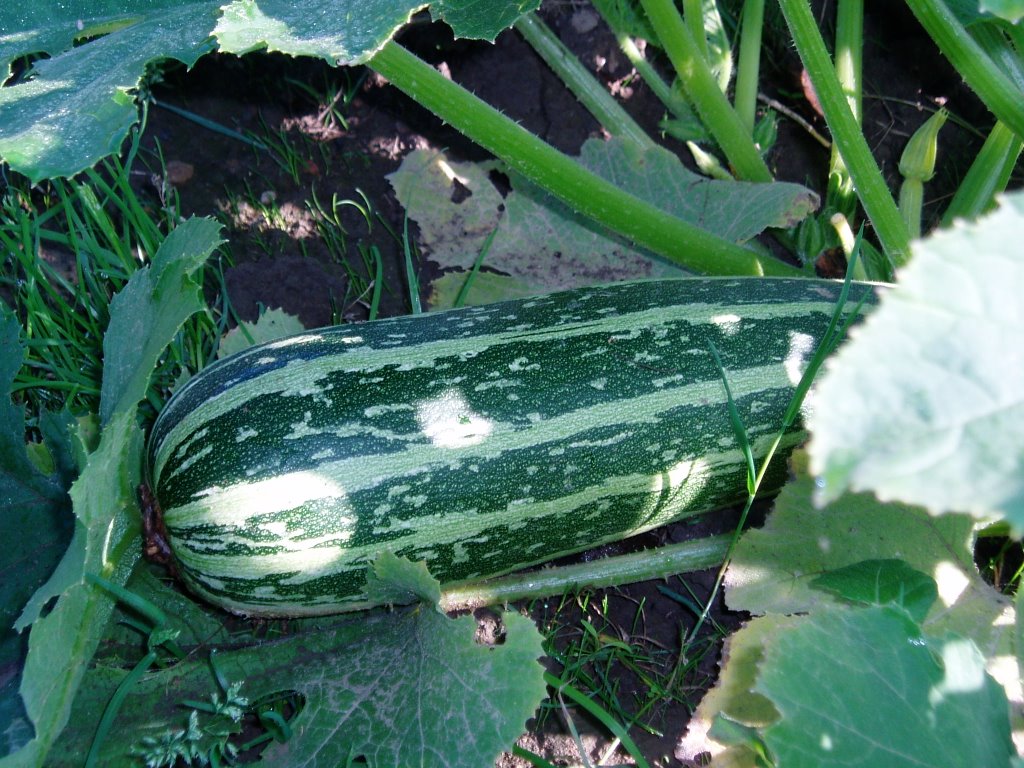
Never mind, at least my marrow is still in with a chance:

And most of all the allotment is an amazing place to go and write, or to just be. Feast your eyes on this (not mine, but we can dream):
especially compared with those of the past (I've tried making this photo smaller to make them look less impressive but it still doesn't work! These are BEASTS!):

Never mind, at least my marrow is still in with a chance:
And most of all the allotment is an amazing place to go and write, or to just be. Feast your eyes on this (not mine, but we can dream):

Friday, August 25, 2006
To mark their 100th edition, The Writers’ & Artists’ Yearbook (a must-have companion for every writer, aspiring or established) has launched a brand new website. As well as details of their 100-year history, the site also includes a guide to getting published and a directory of literary agents. Visit the site here.
Thursday, August 24, 2006
So what makes one piece of literature 'better' than others? The number of prizes it gets might be some answer - after all, one win might be 'lucky' but surely not a shower of them. Interesting then to see this list of awards here, and to look at the short story Mefisto in Onyx by Harlan Ellison, which has won FOUR awards. Puts paid to the idea that you need a short punchy first sentence anyway!
News of an interesting sounding British Academy lecture:
The lectures begin at 5.30pm and take place in the British Academy, 10 Carlton House Terrace, London SW1Y 5AH. Lectures are free and are open to all and will be followed by a reception at 6.30pm.
Tuesday 19 September 2006
CHATTERON LECTURE ON POETRY
A.E. Housman's Rejected Addresses
Dr Robert Douglas-Fairhurst, Magdalen College, Oxford
Ask me no more, for fear I should reply;
Others have held their tongues, and so can I…
A. E. Housman (1859-1936) has often provoked disagreement among his readers, but there is one aspect of his life and work that almost everyone agrees on: he was a reserved, even a repressed figure – ‘self-absorbed, self-contained’ (Katherine E. Symons), ‘reticent and stiff’ (Lawrence Housman), ‘a strange union of deep passion with severe restraint’ (John Sparrow). This lecture will explore how far commonly accepted ideas of repression are helpful in explaining the distinctive qualities of Housman’s voice, and where else the hiding-places of his imagination are to be found. Above all, I aim to show that Housman is a far more unsettled and unsettling poet than many of his admirers like to think. ‘You always know where you are with Housman’, John Bayley once argued; but although A Shropshire Lad led to Housman being rooted in the popular mind as one of English literature’s finest writers of imaginative topography, remoulding the landscape to fit the more obliging contours of memory and desire, it might be better to think of him as one of the great poets of displacement and disorientation. You never know where you are with Housman.
The lectures begin at 5.30pm and take place in the British Academy, 10 Carlton House Terrace, London SW1Y 5AH. Lectures are free and are open to all and will be followed by a reception at 6.30pm.
Tuesday 19 September 2006
CHATTERON LECTURE ON POETRY
A.E. Housman's Rejected Addresses
Dr Robert Douglas-Fairhurst, Magdalen College, Oxford
Ask me no more, for fear I should reply;
Others have held their tongues, and so can I…
A. E. Housman (1859-1936) has often provoked disagreement among his readers, but there is one aspect of his life and work that almost everyone agrees on: he was a reserved, even a repressed figure – ‘self-absorbed, self-contained’ (Katherine E. Symons), ‘reticent and stiff’ (Lawrence Housman), ‘a strange union of deep passion with severe restraint’ (John Sparrow). This lecture will explore how far commonly accepted ideas of repression are helpful in explaining the distinctive qualities of Housman’s voice, and where else the hiding-places of his imagination are to be found. Above all, I aim to show that Housman is a far more unsettled and unsettling poet than many of his admirers like to think. ‘You always know where you are with Housman’, John Bayley once argued; but although A Shropshire Lad led to Housman being rooted in the popular mind as one of English literature’s finest writers of imaginative topography, remoulding the landscape to fit the more obliging contours of memory and desire, it might be better to think of him as one of the great poets of displacement and disorientation. You never know where you are with Housman.
Wednesday, August 23, 2006
There's a powerful story by Maxwell Jay, The Y Incision, up on Pulp's site at the moment. Worth reading.
Tuesday, August 22, 2006
Monday, August 21, 2006
Bluechrome, the excellent publisher of the excellent Messages, has started Random Review, a new campaign linked with the Bookcrossing initiative. Here are details:
Introducing The Random Review - Get a Free Book from bluechrome
For those of you that haven't come across BookCrossing.com it is well worth a visit, not least because it spreads the word about good (and bad) books and promotes literature using old fashioned collaboration. To date nearly half a million people have joined and 'Released' some of their favourite books into the wild, by leaving them in coffee shops, at bus stops and anywhere else people might find them, pick them up and give them a read. We thought it a great idea and wanted to join in, and to do this we'd like your help. The idea of the Random Review is that we will send a handful of each of our new titles to a random selection of those that let us know that they would like to join in, and promises to:
1. Read the book
2. Write a Review, good or bad, and add it to the Book Crossing Web Site
3. Give the book to somebody else or leave it somewhere for somebody to find.
So how do you register your interest? Well all you have to do is send us your name and postal address by e-mail to randomreview@bluechrome.co.uk and we may well send you a book in the very near future. Oh, and mention whether you prefer fiction or poetry books.
Friday, August 18, 2006

One true cliche (actually aren't all cliches true?) is how the best books continue to creep up on you long after you've read them. I'm normally a peaceful sleeper, but last night I woke up in a rage, thinking I just had to hit someone. After I'd happily battered to a pulp several of the people currently on my hate-list against a wall at the end of a dead end I'd chased them down (it was a long and enjoyable process but hey, I've never said I was 'nice'), I started to work my way back to why I was feeling like that.
The answer: Alison Lurie's new novel, Truth and Consequences. Unlike most critics it seems, I LOVE books about writers - after all, you can have the confidence that the author is writing from a position of knowledge, rather than, say, with a vampire story. Delia is the writer in Truth and Consequences and she definitely isn't nice. She hates teaching - all those students wanting things from her, she 'forgot' to tell her second husband she hadn't divorced her first, she manipulates everybody into becoming her slave, and when she's caught red-handed by her lover's wife, her reaction is to burst out laughing. But in one thing she is inspiring. She's completely single-minded about her writing. And oh so disciplined.
And I've just realised that's why I woke up angry - because I haven't been like that for a long time. In fact, the opposite. I spent some time last night getting cross with everybody I could think of who has stopped me writing, but came to the conclusion that the main culprit was, of course, myself. There's a balance - I wouldn't want to run away and leave the kids (well, only sometimes) but I'm going to stop sabotaging my writing by always putting it last.
And here endeth the lesson. Well, nearly. Delia's not all bad. One of her lines made me laugh out loud, and still gets me smiling. It's when she tells Alan she's going to move to Key West, and he replies:
The answer: Alison Lurie's new novel, Truth and Consequences. Unlike most critics it seems, I LOVE books about writers - after all, you can have the confidence that the author is writing from a position of knowledge, rather than, say, with a vampire story. Delia is the writer in Truth and Consequences and she definitely isn't nice. She hates teaching - all those students wanting things from her, she 'forgot' to tell her second husband she hadn't divorced her first, she manipulates everybody into becoming her slave, and when she's caught red-handed by her lover's wife, her reaction is to burst out laughing. But in one thing she is inspiring. She's completely single-minded about her writing. And oh so disciplined.
And I've just realised that's why I woke up angry - because I haven't been like that for a long time. In fact, the opposite. I spent some time last night getting cross with everybody I could think of who has stopped me writing, but came to the conclusion that the main culprit was, of course, myself. There's a balance - I wouldn't want to run away and leave the kids (well, only sometimes) but I'm going to stop sabotaging my writing by always putting it last.
And here endeth the lesson. Well, nearly. Delia's not all bad. One of her lines made me laugh out loud, and still gets me smiling. It's when she tells Alan she's going to move to Key West, and he replies:
'According to what I read, Key West is overrun with homeless chickens and feral six-toed cats, and drugs, and drunken writers and crazy motorcyclists, and the local government is completely corrupt,' he said.
'Yes, doesn't it sound wonderful?' Delia laughed. 'I'm going to be so happy there. Even happier than Henry and Jane.'
Thursday, August 17, 2006
Cosmopolitan magazine after a few gin and tonics?
That's one of the review quotes for Scarlet, the UK's only erotic magazine for women. I went to an all-women talk on erotic writing recently, and really liked what Scarlet's founder, Emily, had to say there about how and why she started the magazine. Actually, it wasn't just what she had to say but how she said it. She made it fun, normal and exciting, and hurrah for that AND her magazine. I'm really pleased WH Smiths are stocking it, and was delighted - if poetically gobsmacked - at Heathrow recently to see so many copies on display.
One of the best quotes I heard all night at the erotic writing talk was on the way out, when my friend and I were joined by another woman who'd been at the meeting. 'Of course we might talk about it, but most of us probably still lie back and think of England', this woman said. 'Not in my house we don't,' said my friend, who's married to a Scotsman.
The meeting was held in the staffroom on the top floor of Foyles, where, appropriately, in pride of place on the wall was a black and white photograph of the shop in the 1960's with a sign saying something like 'Lady Chatterley's Lover Sold Out, More Coming', at the time of the famous court case.
That's one of the review quotes for Scarlet, the UK's only erotic magazine for women. I went to an all-women talk on erotic writing recently, and really liked what Scarlet's founder, Emily, had to say there about how and why she started the magazine. Actually, it wasn't just what she had to say but how she said it. She made it fun, normal and exciting, and hurrah for that AND her magazine. I'm really pleased WH Smiths are stocking it, and was delighted - if poetically gobsmacked - at Heathrow recently to see so many copies on display.
One of the best quotes I heard all night at the erotic writing talk was on the way out, when my friend and I were joined by another woman who'd been at the meeting. 'Of course we might talk about it, but most of us probably still lie back and think of England', this woman said. 'Not in my house we don't,' said my friend, who's married to a Scotsman.
The meeting was held in the staffroom on the top floor of Foyles, where, appropriately, in pride of place on the wall was a black and white photograph of the shop in the 1960's with a sign saying something like 'Lady Chatterley's Lover Sold Out, More Coming', at the time of the famous court case.
Wednesday, August 16, 2006
 Aldeburgh in Suffolk is a magical place - obviously it doesn't snow there all the time, but one thing it does have more than its fair share of is poets. Its poetry festival is justly famous, and I've been drooling over this year's programme already!
Health, Happiness and Social Status
A British Academy discussion between Richard Layard, FBA,
London School of Economics and Political Science,
and Michael Marmot, University College London
Convened by Shula Marks, FBA,
University of London, School of Oriental and African Studies
and supported by the Academy of Medical Sciences
Chair: Onora O'Neill, President of the British Academy
Wednesday, 4th October 2006
6.00pm - 7.30pm
£10 (£5 concessions) to include a drinks reception
The British Academy, 10 Carlton House Terrace,
London, SW1Y 5AH
An evening dialogue between the epidemiologist Sir Michael Marmot and the economist Lord Richard Layard, FBA, both of whom have recently written fascinating books at the interface of medicine/ well-being and the social sciences.
Michael Marmot’s Status Syndrome: How your social standing directly affects your health, derives from his internationally renowned study of hierarchy and health in the civil service which shows how health is closely related to the degree of control we have over our lives; Richard Layard’s Happiness. Lessons from a New Science brings together recent research in the neurosciences and economics to explore `the causes of happiness and the means we have to affect it'. The books are both remarkable and complementary; lucid and extraordinarily accessible. If confirmed, the findings they integrate have profound implications for the political agenda of Western countries.
Please circulate this email to interested colleagues and students.
Visit our website for further details and to to book on-line:
www.britac.ac.uk/events/2006/hhss/
Telephone enquiries: 020 7969 5238 / Email: externalrelations@britac.ac.uk
A British Academy discussion between Richard Layard, FBA,
London School of Economics and Political Science,
and Michael Marmot, University College London
Convened by Shula Marks, FBA,
University of London, School of Oriental and African Studies
and supported by the Academy of Medical Sciences
Chair: Onora O'Neill, President of the British Academy
Wednesday, 4th October 2006
6.00pm - 7.30pm
£10 (£5 concessions) to include a drinks reception
The British Academy, 10 Carlton House Terrace,
London, SW1Y 5AH
An evening dialogue between the epidemiologist Sir Michael Marmot and the economist Lord Richard Layard, FBA, both of whom have recently written fascinating books at the interface of medicine/ well-being and the social sciences.
Michael Marmot’s Status Syndrome: How your social standing directly affects your health, derives from his internationally renowned study of hierarchy and health in the civil service which shows how health is closely related to the degree of control we have over our lives; Richard Layard’s Happiness. Lessons from a New Science brings together recent research in the neurosciences and economics to explore `the causes of happiness and the means we have to affect it'. The books are both remarkable and complementary; lucid and extraordinarily accessible. If confirmed, the findings they integrate have profound implications for the political agenda of Western countries.
Please circulate this email to interested colleagues and students.
Visit our website for further details and to to book on-line:
www.britac.ac.uk/events/2006/hhss/
Telephone enquiries: 020 7969 5238 / Email: externalrelations@britac.ac.uk
Tuesday, August 15, 2006
Everybody needs a daily annoyance, one that will mildly stimulate but not tip you over the edge. Mine comes from my page-a-day Zen calender - today's entry:
Yun-yen was sweeping the grounds.
“You are very busy,” Tao-wu commented.
“You should know that there is someone who isn’t busy.”
“Oh really?” Tao-wu said. “You mean there’s a second moon?”
Yun-yen held up his broom and said, “Which moon is this?”
ZEN MONDO
Monday, August 14, 2006
Back to the rain, and the rain, and the rain ....
Two things that cheered me up today are both lists - firstly a pick of rainy songs from a New Orleans based blogger called Adrastos I've been reading, and secondly the top comedy lines from the BBC. Peter Kay wins with his '"Garlic bread, it's the future, I've tasted it" line, but I must admit still laughing every time I hear Caroline Aherne's question to Debbie McGee as to why she married magician Paul Daniels: "So, what first attracted you to the millionaire Paul Daniels?"
Thursday, July 27, 2006
Wednesday, July 26, 2006

There are, of course, many things for a writer to be jealous of J K Rowling for, but high up on my list is her public recognition as the 'number one' fan of Elizabeth Goudge's classic, The Little White Horse. This book made a real impression on me as a child, and I relived and tasted again and again the details in it - the way the orphan Maria got comfort just from knowing she wore beautiful shoes under her long gown, the iced biscuits left in the turret bedroom, in fact so much so that I deliberately laced oblique references through my own novel, Something Beginning With. I didn't expect anyone to pick them up, they were just there for my pleasure! Now I've just heard that The Little White Horse is being made into a film, and there's been a short story competition - for children and young adults - attached to it. One of the winning entries can be found here, and - oh my god - there's even a biscuit recipe up on the site. I should feel pleased, but I feel a little bewildered and plundered. It's happened before when I've really enjoyed a book - half of the time I want EVERYONE to love it too, but there's a little bit of me that wants to keep the experience private because reading it has been such a personal and transformational pleasure. Writing this makes me realise how bizarre this is - anyone else feel it though?
My writing prompt for today is going to be .... biscuits.
Monday, July 24, 2006
I love the book club I'm in with a passion. When I was new to the area and knew only one person, she was good enough to take me along. Can't remember what the first book we read was, but I do know I've made some serious friends. Move over Richard and Judy - our books to read for the summer are Jane Eyre (we did Wide Sargasso Sea last time) and Never Let Me Go. I was interested then in this report from my US publishers, Ballantine, of the first Book Club Conference. It would be great if they could do something like this in the UK.
And my belated writing prompt for today is going to be ... the babysitter's arrived. (that's my prompt not the reason for stopping writing this!)
And my belated writing prompt for today is going to be ... the babysitter's arrived. (that's my prompt not the reason for stopping writing this!)
Sunday, July 23, 2006
 Not sure quite what trail took me to this site, but there's something very beautiful about the plastics developed from recycled products on the Smile-plastics website. This one is from shredded banknotes, but there are others made with mobiles, bottles, carrier bags, cd's, stamps etc etc etc. The plastic is then used for furniture, interior design, exterior design, plates, you name it. Even - looking at the thumbnail sketches on the website - for a guitar.
Saturday, July 22, 2006
I'm going to steal my prompt for today from the excellent 400 words website which asks for short non-fiction pieces (well funnily enough 400 words actually). There are two great pieces to read on the theme of compulsion, so that's what I'm going to write about today, and tomorrow I'm going to try a 400 word autobiography because I'm inspired by the ones that are up on the site.
Friday, July 21, 2006
As edition editor of the latest copy of Writers in Education, published by NAWE, one of the pieces that really excited me was an article on using science in writing by Ann Lackie. This wasn't just because it was interesting and well-written, but because it got me interested in science, something I'm ashamed to say years of school teachers never managed to do! So, I'm very pleased Dr Jennifer Rohn, editor of Lablit, has kindly allowed me to copy her favourite 'lablit' books on my blog. The site is well worth a visit, not just because of the interesting article by the novelist, Clare Dudman. In addition, news of 'lablit' (I'm going to keep repeating that, I love it!) publishing can be found here, and this list is constantly updated.
Dr Jennifer Rohn writes: Science in literary fiction occurs along a continuum, from passing references and peripheral scientist characters to a rich, full-blown experience in which realistic scientists feature as central characters and their research endeavors underpin the plot. What makes this latter end of the spectrum, which I call 'lab lit', so engaging is that while the delivery of the science is still subtle and unobtrusive, and human interest vitalizes the narrative arc, the reader is effortlessly drawn into a hidden world viewed from a scientist's eyes. Such a perspective is rare in today's environment where, despite the saturation of science in our media, non-stereotyped representations of researchers and their craft rarely see the light of day. I estimate that there have been only a few dozen pure 'lab lit' novels ever written; these are five of my favorites:
Cantor's Dilemma (Carl Djerassi)
A cancer researcher throws integrity to the wind in pursuit of the Nobel Prize. Immersed in my PhD research in the 80's, this was the first 'lab lit' book I ever encountered, and I was equally delighted to find a novel set in my beloved world and bemused that there seemed to be so few other examples.
Paper (John McCabe)
This black comedy/thriller features a disgruntled biochemist propelled from his tedious research rut by a second-hand laptop full of suspicious DNA code - 'lab lit noir' at its finest. When I read this in the 90's, I too was a disillusioned postgrad, and the experience resonated.
Mendel's Dwarf (Simon Mawer)
An intellectual, bittersweet story of a dwarf geneticist studying the molecular basis of his own condition; in the process, egomania and self-hatred mutate into enlightenment.
Long For This World (Michael Byers)
In this tense tale of love and hubris, a medical geneticist becomes so fond of his pediatric patient that he decides to treat the child in secret without going through the proper ethical channels.
Intuition (Allegra Goodman)
'Lab lit' hits the bestseller lists this year, giving the genre a well-deserved boost of popular exposure: Secrets, lies and scientific fraud threaten to tear apart a close-knit cancer laboratory in Boston.
Thursday, July 20, 2006
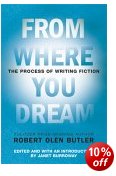 Another student recommended the book, From Where You Dream by Robert Olen Butler, a series of essays on writing from his lecture series at Northwestern Unversity, and edited by Janet Burroway. It's been just what I need to kickstart both my writing discipline and inspiration, and somehow seems ideally suited to the weather. One of the many paragraphs I've underlined are these ones:
 You know, it's easy to get caught up in the ambition of being a writer. It's easy to get caught up in loving literature and wishing to be the person on the dust jacket. This ambition, as innocent-seeming as it is, can very easily muscle out your deeper, more delicate, more difficult ambitions ... What I want to nurture in you is the impluse: "I'm ravished by sensual experience. I yearn to take life in. My God! I've got this sense that the world has meaning. Things roil around in my dream space, and I've got to figure out how to make art objects of them." That's really the best ambition, to be hungry for sensual experience in your life. Ravenous. Artists are not intellectuals. We are sensualists. The objects we create are sensual objects, and the way you'll know that you're writing from your head is that you'll look at your story and find it full of abstraction and generalization and summary and analysis and interpretation....
Mies van de Rohe said that God is in the details. Let's substitute: the human condition resides in the details, the sense details.
The primary point of contact for the reader is going to be an emotional one, because emotions reside in the senses.
So my writing prompt for today is a nice one: I'm going to allow myself to be ravished by my senses!
And, if like me, reading his thoughts on the writing process has sent you back to re-reading Robert Olen Butler's own creative work, a short story of his, 'Woman Struck by Car Turns into Nymphomaniac', can be found here. (Actually, I'm setting hundreds of sexy google searchers up for disappointment with putting that title there, but welcome to you all anyway - particularly those who combined Nymphomaniac with car in their search criteria, may all your motoring fantasies come true!)
Wednesday, July 19, 2006

When Messages was published, Lynne and I opened our own yahoo email account - messagesproject@yahoo.co.uk - if anyone felt inspired to write a Message based on any of ours. Of course, we hoped, but didn't really expect, we'd get responses but I'm so happy that we are. It's as if the book, having started as an energetic collaboration between us two, has now opened itself out for other people to respond to the links. Someone's even suggested we publish Messages 2 of all the new 300-word pieces. I love that idea. Bob has even started his own Tuesday 200 project here.
So today's the anniversary of the first publication of Lord of the Rings. Here's what the Writer's Almanac say about it...
And my writing prompt today is going to be .... half a million words (not writing them but just am image of them... although who knows how inspiring this may turn out to be!!!).
It was on this day in 1954 that the first part of the Lord of the Rings trilogy was published—The Fellowship of the Ring. Seventeen years had passed since the publication of The Hobbit (1937), to which The Fellowship of the Ring was a sequel. The Hobbit had gotten a great review in The Times Literary Supplement, and it went on to become a best-seller. So J.R.R. Tolkien (books by this author) began working on a sequel, about the nephew of the hobbit Bilbo, the nephew being named Frodo. He decided that the story would center on the magical ring, which hadn't been an important part of The Hobbit.
Tolkien spent the next seventeen years working on The Lord of the Rings. He was well into his first draft by the time World War II broke out in 1939. The book became more complicated as Tolkien went along, and it was taking much longer to finish than he had planned. He went through long stretches where he didn't write anything and considered giving the project up altogether. He wanted to make sure all of the details about the geography, language, and mythology of Middle Earth were consistent. He made elaborate charts to keep track of the events of his story, showing dates, days of the week, the direction of the wind, and the phases of the moon.
Finally, in the fall of 1949, Tolkien finished writing The Lord of the Rings. He typed the final copy out himself, sitting on a bed in his attic, balancing the typewriter on his lap, and tapping it out with two fingers.
The Lord of the Rings turned out to be more than half a million words long. Tolkien wanted to publish it in one volume, his publisher wanted to divide it into three volumes and so the first volume, The Fellowship of the Ring, came out on this day in 1954.
Only about three and a half thousand copies were printed, but it turned out to be incredibly popular, and it went through a second printing in just six weeks.
And my writing prompt today is going to be .... half a million words (not writing them but just am image of them... although who knows how inspiring this may turn out to be!!!).
Tuesday, July 18, 2006

I'm me-e-e-e-l-l-lting here... but it could be worse. Just come back from London where a guy on the tube was reading a paper with the front page saying it was 52 on the buses, more than double the recommended temperature for transporting cattle.
And my writing prompt for today comes from my book of 52 Projects and is number 45, because however hot I am I can spend at least one minute writing! It is to write a one-minute autobiography and this is what the book says:
'Don't necessarily start at the beginning, and don't worry about the ending. Indeed, do not let any kind of chronological order hinder your effort. A good place to start is the first thing that comes to mind. Once you start writing, other memories will pop into your head. Go with them. The inneruptions enhance the flow. Once the minute is up, read over what you have written, and then immediately repeat the exercise. Keep going for as long as you can.'
Monday, July 17, 2006
I'm not normally too keen on anti-men jokes, but this list made me laugh. A lot!
It is good to be a woman:
-------------------------
1. We got off the Titanic first.
2. We can scare male bosses with the mysterious gynecological disorder excuses.
3 Taxis stop for us.
4. We don't look like a frog in a blender when dancing.
5. No fashion faux pas we make, could ever rival the Speedo.
6. We don't have to pass gas to amuse ourselves.
7. If we forget to shave, no one has to know.
8. We can congratulate our teammate without ever touching her rear end.
9. We never have to reach down every so often to make sure our privates are still there.
10. We have the ability to dress ourselves.
11. We can talk to the opposite sex without having to picture them naked.
12. If we marry someone 20 years younger, we are aware that we will look like an idiot.
13. We will never regret piercing our ears.
14. There are times when chocolate really can solve all your problems.
15. We can make comments about how silly men are in their presence because they aren't listening anyway.
If you're submitting regularly, you may already have heard of Duotrope but it's definitely worth a visit. It has up to date information, easily categorised, of virtually every journal out there, plus a system whereby you can keep control of your own submissions. If you use it, consider supporting it with a donation too - part of the wonder, for me, is that it's free!
Friday, July 14, 2006
OK, let's talk stalking, and my writing prompt mission yesterday.
Straight off the train, I followed a woman of about 40. Everything about her glittered, her dyed blonde hair, earrings, sparkly flip-flops, silver belt. She had no bag - that's what drew me to her, how can you survive with no bag? Even her pockets looked flat. She kept looking behind her, so at first I thought she'd spotted me, but then I realised she was just trying to catch her reflection in all the shop windows. I thought she must be going somewhere good but then she dashed into a coffee shop and I'd made a rule for myself that I would only follow in the street, so I left her.
Next up were two friends, about twentyish, both with those ballerina type skirts of many fluttery layers. Even the way they walked down the street was floaty and curvy but then I realised they were so busy talking, it was irrelevant to them where they were going and suddenly they didn't interest me any more.
So then I found suspect 4, a bald man with a huge orange rucksack and those shorts like babies wear that give all men the same bowed baby legs. Boy did he walk fast - dashing into roads, zigzagging round cars, I ended up running up streets after him. If someone I knew had stopped me, I would have ignored them. I could feel my blood race. And then suddenly we slowed down and I saw there were two policemen ahead of him. I wondered if policemen on foot were like those in a car, you just can't overtake them. But eventually we managed it, my heart thumping. This chase gave a whole new feel to Covent Garden, rarely have I been in such a hurry to get ... where?
And then just when I was wondering how much further I could run, he was gone. Completely. Between two cafes and a dead end. I gazed in one cafe window to try to find him and a guy waved at me, but he wasn't my guy. He was nowhere. I felt like a hunter must feel when he'd lost his chance of a kill. I just stood there. I really didn't know where to go, a wind up toy wound down.
But then I saw a stationery shop with a sale and the spell was broken, although I couldn't stop laughing for about an hour after. I felt mad but alive, aware of how much more I was noticing all the small details that might have passed me by before: a Chinese boy with his arms around his elderly parents, the teenage girl reading Jane Eyre as she walked down the street, how men who've obviously been fit in their youth put on weight from chest up so they have no necks, the couple flirting by the 'Fool for Love' poster.
And my writing prompt for today is going to be to ... write as if I'm following myself.
Straight off the train, I followed a woman of about 40. Everything about her glittered, her dyed blonde hair, earrings, sparkly flip-flops, silver belt. She had no bag - that's what drew me to her, how can you survive with no bag? Even her pockets looked flat. She kept looking behind her, so at first I thought she'd spotted me, but then I realised she was just trying to catch her reflection in all the shop windows. I thought she must be going somewhere good but then she dashed into a coffee shop and I'd made a rule for myself that I would only follow in the street, so I left her.
Next up were two friends, about twentyish, both with those ballerina type skirts of many fluttery layers. Even the way they walked down the street was floaty and curvy but then I realised they were so busy talking, it was irrelevant to them where they were going and suddenly they didn't interest me any more.
So then I found suspect 4, a bald man with a huge orange rucksack and those shorts like babies wear that give all men the same bowed baby legs. Boy did he walk fast - dashing into roads, zigzagging round cars, I ended up running up streets after him. If someone I knew had stopped me, I would have ignored them. I could feel my blood race. And then suddenly we slowed down and I saw there were two policemen ahead of him. I wondered if policemen on foot were like those in a car, you just can't overtake them. But eventually we managed it, my heart thumping. This chase gave a whole new feel to Covent Garden, rarely have I been in such a hurry to get ... where?
And then just when I was wondering how much further I could run, he was gone. Completely. Between two cafes and a dead end. I gazed in one cafe window to try to find him and a guy waved at me, but he wasn't my guy. He was nowhere. I felt like a hunter must feel when he'd lost his chance of a kill. I just stood there. I really didn't know where to go, a wind up toy wound down.
But then I saw a stationery shop with a sale and the spell was broken, although I couldn't stop laughing for about an hour after. I felt mad but alive, aware of how much more I was noticing all the small details that might have passed me by before: a Chinese boy with his arms around his elderly parents, the teenage girl reading Jane Eyre as she walked down the street, how men who've obviously been fit in their youth put on weight from chest up so they have no necks, the couple flirting by the 'Fool for Love' poster.
And my writing prompt for today is going to be to ... write as if I'm following myself.
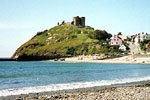 I'm counting the weeks now until my course at Ty Newydd - Exploring Fiction with Jim Friel. Apparently there are still places if anyone wants to find out more, and the centre is beautiful since its recent facelift - can't wait!
Thursday, July 13, 2006
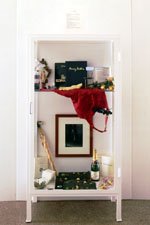 When teaching writing becomes not just enjoyable, but actually a privilege, is when you learn as much from your students as you're teaching them. (You mean you get paid for that? Yep, life's good!) My best tutorials - on both sides - are those when we both come away bursting with scribbled names, notes and books to look up. So this entry comes with thanks to Brigitte who introduced me to the work of the French artist, Sophie Calle; Paul Auster fans might recognise her as the model for Maria, in his novel, Leviathan. Sophie Calle is the ultimate artist at transforming her life, and those of strangers and friends, into art.
 Reading about her, she appears to be an obsessive who uses ritual to anchor her in life. The photograph above is one of a series of exhibits of birthday presents that were given to her every year - she stopped when she was forty. She decided to keep the presents she was given as a record of affection rather than to use them.
Perhaps her most controversial work was The Address Book where she found a stranger's address book and proceeded to contact names in it to build up a picture of the man; this was then published in a French magazine. Not surprisingly the man tried to sue for defamation of privacy, and eventually got hold of a nude photograph of Sophie which he demanded the newspaper publish!
My favourite though is The Shadow, where she asked her mother to hire a private detective to follow her, Sophie, one day. The text on the day is electric - as it progresses, Sophie sounds as if she's almost falling in love with her shadow, wondering what he'll think of her doing this, or that, and how he'll react to her. TO complicate things further, she asks a friend to shadow the shadow and provide a record of who he is. The difference between her account of the day, and the eventual technical report of the private detective is beautiful in itself. The idea came after Sophie came back to live in Paris after an absence and, feeling an outsider, started to follow strangers.
I've been feeling almost electrically inspired reading about this woman and although there's no copying her, my writing prompt for today comes from her... I'm going to London today to meet my friend Shaun for lunch and I'm going to take an earlier train than I would normally and meander round after strangers for an hour. And my 'living' prompt for today is ... not to get arrested!
Brave New Roles
Deadline: 30 September 2006
Sphinx Theatre Company is pleased to announce a new award for the playwright who creates the most interesting role for a woman in a new play.
This is a scheme designed to create a body of work containing stronger roles for women in contemporary plays.
The winning playwright will be awarded £2000 in addition to a commissioning fee and the successful play will be presented as part of the Brave New Roles showcase.
Five additional short-listed writers will also have their pieces performed as part of the award's lunchtime showcase. The winning play will be produced in 2007/2008.
The award will go to the writer whose play contains the most interesting and strongest role(s) for a woman. Merit will be given to characters which move away from the usual stereotypes of women, often seen in theatre.
Judges for the Award include: Gemma Bodinetz (Liverpool Playhouse and Everyman Theatres), Jack Bradley (National Theatre), Rebecca Lenkiewiecz, actress Tanya Moodie, Sue Parrish (Sphinx Theatre Company) and actress,writer and director Janet Suzman. Liverpool Everyman and Playhouse, Manchester Royal Exchange, York Theatre Royal and Soho Theatre are proud to be associated with this initiative and award.
To be considered for the award writers must be UK residents and qualifying plays must be previously unperformed and over 30 minutes in length. Submissions cannot be accepted by email or on disk.
Please send two typed, unbound copies with a covering letter and CV including your name, address, telephone number and email address to:
Brave New Roles
c/o Sphinx Theatre Company
25 Short Street
London, SE1 18LJ
For more information on Sphinx Theatre Company, please see their website.
Deadline: 30 September 2006
Sphinx Theatre Company is pleased to announce a new award for the playwright who creates the most interesting role for a woman in a new play.
This is a scheme designed to create a body of work containing stronger roles for women in contemporary plays.
The winning playwright will be awarded £2000 in addition to a commissioning fee and the successful play will be presented as part of the Brave New Roles showcase.
Five additional short-listed writers will also have their pieces performed as part of the award's lunchtime showcase. The winning play will be produced in 2007/2008.
The award will go to the writer whose play contains the most interesting and strongest role(s) for a woman. Merit will be given to characters which move away from the usual stereotypes of women, often seen in theatre.
Judges for the Award include: Gemma Bodinetz (Liverpool Playhouse and Everyman Theatres), Jack Bradley (National Theatre), Rebecca Lenkiewiecz, actress Tanya Moodie, Sue Parrish (Sphinx Theatre Company) and actress,writer and director Janet Suzman. Liverpool Everyman and Playhouse, Manchester Royal Exchange, York Theatre Royal and Soho Theatre are proud to be associated with this initiative and award.
To be considered for the award writers must be UK residents and qualifying plays must be previously unperformed and over 30 minutes in length. Submissions cannot be accepted by email or on disk.
Please send two typed, unbound copies with a covering letter and CV including your name, address, telephone number and email address to:
Brave New Roles
c/o Sphinx Theatre Company
25 Short Street
London, SE1 18LJ
For more information on Sphinx Theatre Company, please see their website.
Wednesday, July 12, 2006
My first ever creative fiction publication was a short story taken by QWF Magazine, and I was so excited I slept with the acceptance letter from the scarey sounding editor, Jo Good, under my pillow. Since then, I've had several other stories published by the magazine, spoke at the annual conference and, having got to know and like Jo, looked on with admiration as she's managed to enthusiastically keep her dream alive of encouraging other women writers, and publishing some of the best fiction around. All this probably to the detriment of her own creative work, because she's a talented writer as well as an editor. I've just heard today that Jo is stepping down from the magazine, although she's keeping charge of the excellent Phillip Good Memorial Prize, a short story competition named in honour of her late first husband. Anyway, just wanted to use this opportunity to say a big THANK YOU to Jo - you never forget your first time! - and to wish the new editor, Kathie Giorgio all the best.
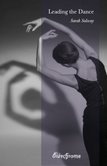 Voila! The beautiful cover design for my collection of short stories, coming in November from Bluechrome. I'm not sure, but I think I might even prefer gazing at this over the Johnny Depp pic.
Monday, July 10, 2006
Why do I blog? To note down ideas/websites/thoughts as much for myself as to share them for other people; as a form of discipline but mostly as a way of being part of a community of other writers I admire - there's a certain energy, enthusiasm, humour, openness about blogging writers for the act of writing that has nothing to do with publishing contracts, W H Smith placements or bestselling lists and I value that. I could just read them, I suppose, but I like taking part in it all too. John Baker has been asking bloggers just that question. Worth a look.
And my writing prompt today is ... the question why.
And my writing prompt today is ... the question why.
Sunday, July 09, 2006
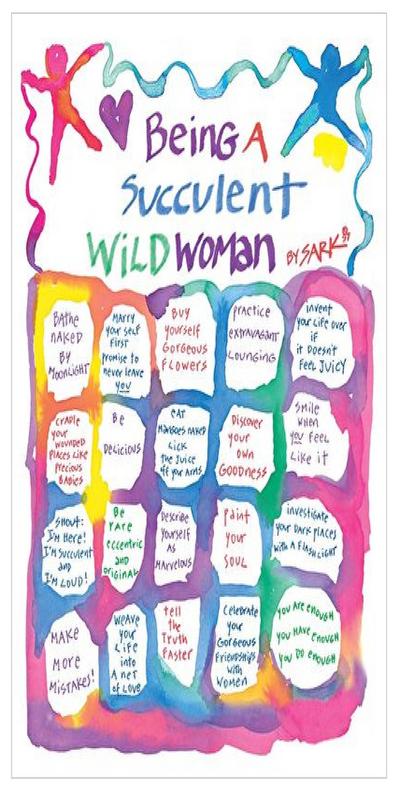
I've said it before, and I'll say it again, I LOVE browsing on the 43things website. At the moment, there's a campaign going on for cheering and being one of Sark's 'Succulent wild women', which makes me laugh - in the best non-cynical happy way. I'm inspired by the 'juiciness' and generosity of it all. Go girls - here's a big cheer!!!
And my writing prompt for today is going to be from the list of random goals put up by 43things:
The world wants to...
use age progression software on my picture finish what I've started go to medical school Send something to post secret Finish what I start see more live music create a personal travel map take up photography Skydive Be baptized See the Mark Ryden exhibit at the Frye Art Museum hike the appalachian trail get merried Become More Politically Active. Get more sleep Lose 10 pounds pass the bar Learn German fluently learn italian find the love of my life enjoy the moment Go check out the Cathedral Park haunting make my own clothes learn to install an electrical outlet learn french fluently become a surgeon stop buying things i dont need. have a house with hidden rooms and trap doors, and some kind of secret tunnel
Saturday, July 08, 2006
It's not often I stay in the car to finish listening to something on the radio, but I did yesterday with a really fantastic radio drama on BBC Radio 4's Woman's Hour. It was the final slot in a drama that had been going on all week, 'Standing Still, Running' by Elizabeth Reeder, and I've just been online to track down the rest of the story. Hurrah for the internet, because it's all there. I recommend this one - it's a great example of multi-voiced storytelling with four women telling their stories after a shooting in Washington DC.
And my writing prompt for today is going to be to tell the same story from four voices.
And my writing prompt for today is going to be to tell the same story from four voices.
Friday, July 07, 2006
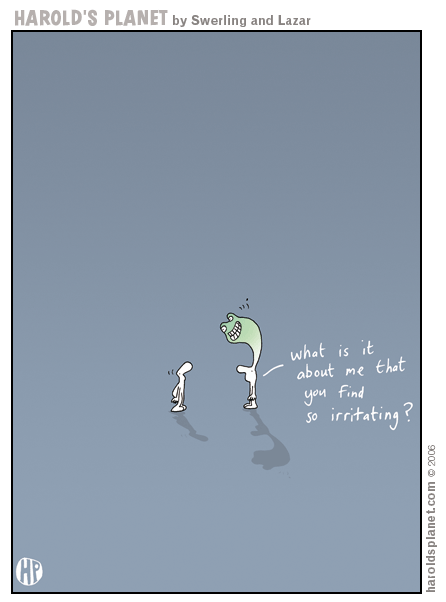
 Somehow the wonderful cartoons I get weekly from the wonderful Harolds Planet always sum up how I'm feeling. This is definitely a site worth exploring, and better than the horoscope I get daily. Mind you, today's horoscope for me (Virgo) says that I could be called on to be a teacher today, and everyone will be astounded by how much I know. As I'm just about to leave to go to my university teaching, I'm certainly hoping that's the case!
Thursday, July 06, 2006

 It was the Paris Hilton 'Don't be Jealous' t-shirt that got me first interested in the brilliant named moretvicar site, but this is the one I want to order.
 And my writing prompt for today is going to be ... jealousy.
Wednesday, July 05, 2006

Just read a poem that has made the hairs stand on the back of my neck in its chilling control. Divorce by Carrie Etter was published in the British Council's New Writing 14 anthology.
For my writing prompt today I'm going to take this theme - Ritual.
For my writing prompt today I'm going to take this theme - Ritual.
Tuesday, July 04, 2006
I suppose it had to happen - a website devoted solely to dog fashion-wear and called Desperate Househounds. Don't know why I'm surprised actually - we have a dog accessory shop in our town called 'Pucci'!
Fancy creating some really evil characters? The Seventh Sanctum website has a dark name generator to help you get started. I particularly like the names for pirate ships and am sure if I write something good enough, Johnny Depp will star in the film, so my writing prompt for today is going to be the wicked but strangely attractive pirate, SLYBURN, aboard the pirate ship, THE EVIL DEATH OF THE EAST. Phew!
Monday, July 03, 2006
A really extraordinary life-story here. I love the idea of her pupils watching Penelope Lawrence swim daily between the two piers at Brighton, so my writing prompt for today is going to be someone that swims outside every day.
Sunday, July 02, 2006
I respect the writer Amy Hempel so much that anything I can read about her, as well as her writing, is welcome. So am very pleased to find this new interview with her (good resource for other writers too). One question she was asked was what piece of creative writing advice would she give:
And my writing quote for today is going to be ... waiting for a storm.
Not so much a piece of advice as a question to keep in mind, which is the most basic of questions: Why are you telling me this? Someone out there will be asking, and you better have a very compelling answer, or reason.
There are people who have been raised by loving parents to believe that the world awaits their every thought and sentence, and I'm not one of them. So I respond to that. Is this essential? The question might be, Is this something only you can say — or, only you can say it this way? Is this going to make anyone's life better, or make anyone's day better? And I don't mean the writer's day.
And my writing quote for today is going to be ... waiting for a storm.
Saturday, July 01, 2006
I've been using mind maps for some time for my writing - particularly with poetry to see the connections and links that I can use, but have always thought of them as something best done with pen and paper so I can scribble and colour as I want - see here for some particularly beautiful ones. However, I've just been playing with a computer based version that seems to work well. I love the little bombs and happy faces I can add, hours of happy not-writing ahead I can see!
And my writing prompt today is going to be ... happy faces.
And my writing prompt today is going to be ... happy faces.
Thursday, June 29, 2006
Ever had your writing rejected? (No? Really? Then get off this blog please. Right now! It's human beings only welcome here.) Anyway, this video clip surely made me feel better!
A friend's just sent me this:
Can you raed this?
I cdnuolt blveiee that I cluod aulaclty uesdnatnrd what I was rdanieg. The phaonmneal pweor of the hmuan mnid, aoccdrnig to a rscheearch at Cmabrigde Uinervtisy, it dseno't mtaetr in what oerdr the ltteres in a word are, the olny iproamtnt tihng is that the frsit and last ltteer be in the rghit pclae. The rset can be a taotl mses and you can still raed it whotuit a pboerlm. This is bcuseae the huamn mnid deos not raed ervey lteter by istlef, but the word as a wlohe. Azanmig huh? Yaeh and I awlyas tghuhot slpeling was ipmorantt!
Tuesday, June 27, 2006
Kirsty Wark's interview with Seamus Heaney about his new collection, District and Circle, took place in April, but I've only just found it. I love his description of poetry as the 'fortification of inwardness', particularly when he's talking about writing in an age of anxiety.
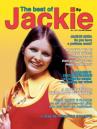 OK. Sit tight, girls of the seventies. In the course of researching a poem about communal changing rooms (remember them? where were the trumpets when they went out of fashion?) I've just discovered here that Cathy and Claire, doyens of Jackie magazine's problem page, didn't actually exist! Theirs was the first page we turned to every week, and my best friend and I even wrote to them once, only half as a joke, to say we had a crush on a sixth former who ignored us. 'They' (we always pictured them like the two women from Abba) wrote back and told us to take up more sport at school, and had we thought of hobbies. I feel cheated. Good news is that they've produced a Best of Jackie annual. I love the Amazon review from a 13 year old girl who seems amazed that anything her mum read could be interesting, but not as much as the fact the double-offer is with David Cassidy's Daydreamer. Now you're talking.
My writing prompt for today is going to be ... writing to a problem page.
Monday, June 26, 2006
Bonnie Friedman probably writes the best about the role of envy in a writer's life. It isn't clever, it isn't nice, and it certainly isn't good for writing, but it happens and the publishing system we have encourages it. Once I acknowledged that, I felt so much better! So this is a homespun way of introducing one writer I was envious of for a long time when my first book, Something Beginning With, came out, because it seemed there were displays of Kate Long's book, The Bad Mother's Handbook, in every bookshop I went into, reviews and interviews in every newspaper and copies in everybody's hands!. This was the only - pathetic, petty, poor - reason I spent a long time being probably the only person in the country who hadn't read it. So when I was sent a copy to blurb by a US publisher, it felt this was something I had to get over. And, guess what, I LOVED it from the first page!! In fact, I loved it so much that I was reading it on the train once, the tears absolutely pouring down, when the man opposite touched my arm and asked whether I was all right. I told him I was more than all right and this was a book he absolutely had to read. He looked a bit scared and got off at the next stop! I wrote the blurb, putting as a private message to the publisher: 'Kudos to Kate Long' and that's what they ended up using. But I really did want to acknowledge her good writing and control in the book so I didn't mind, and now Kate's become an e-friend, so I've gained doubly! Anyway, her third book, Queen Mum has just come out and I've ordered my copy. Can't wait. This is what Kate says about the book on her website:
And you can see her talking about the book here.
Queen Mum is the story of married mum Ally and her relationship with the family next door, in particular the beautiful Juno, who seems to glide through life with effortless grace. But when Juno takes part in the reality-tv show ‘Queen Mum’, Ally discovers a whole new side to the woman she thought was her best friend.
When I wrote this novel I wanted to look at the way in which we edit reality every day to fit in with our individual world view. As far as I can see, reality-tv is only an extension of this.
And you can see her talking about the book here.
A list of events here all taking place at the wonderful LONDON REVIEW BOOKSHOP
14 Bury Place, London WC1A 2JL
Tel: 020 7269 9030 Fax: 020 7269 9033
Email: books@lrbshop.co.uk
EVENTS
Platonov’s Fourteen Little Red Huts
29 June at 7 p.m.
In association with Academia Rossica, Robert Chandler, leading translator of the Russian writer Andrei Platonov, will introduce the play, explain how it came to be written and compare the relative differences in translating a play from prose. After a brief interval, a shortened version of the play will be performed by professional actors under the direction of Noah Birksted-Breen of the International Freedom Network. The play, written in 1932-3, addresses the hunger, trauma and confusion which accompanied a period of rapid collectivization and the unmasking of unexpected “class enemies”.
13 July at 7 p.m.
Bill Buford set out to write a feature about a chef called Mario Batali, but ended up on an adventure which dominated his life for years. In Heat (Cape), he describes his time as a “kitchen bitch” in the trendy New York restaurant Babbo, shooting game with Marco Pierre White in Britain and finally studying pasta making in an Italian hillside trattoria and butchery with a Dante-quoting butcher. Buford has been editor-in-chief for Granta magazine and fiction editor at The New Yorker, for whom he is now a staff writer and European correspondent.
Michael Gray on Bob Dylan
18 July at 7 p.m.
Andrew Motion called Michael Gray’s Song and Dance Man “the best book there is on Bob Dylan”. Recognised as a world authority on Dylan’s work, Gray has now compiled The Bob Dylan Encyclopaedia (Continuum), a monumental compendium from Baudelaire to the Basement Tapes, charting the impact he has made on the cultural landscape of the 20th and 21st centuries. This event will be a one-man- show with sound.
Peter Porter ‘Under the Influence’ of Arnold and Clough
20 July at 7 p.m.
Australian poet Peter Porter has influenced a lot of the best British poets writing today, but this evening, uniquely, he will talk about two nineteenth-century poets who have influenced him. Reading from his work, and the work of Matthew Arnold and Arthur Hugh Clough, he will discuss what he loves and admires about them, and how, both in language and sensibility, they inspired and enriched his work.
This event is part of the Poetry Society’s Under the Influence series, in conjunction with the London Review Bookshop. It is a unique opportunity to hear and ask about how working poets make use of their poetic ancestors.
Tickets £10 (£5 LRB subscribers, Poetry Society members and concs)
To book tickets with a credit or debit card call 020 7420 9895. For more information visit www.poetrysociety.org.uk
Under the Influence will continue with Helen Dunmore under the influence of Keats (21 September) and Ruth Padel under the influence of Tennyson (23 November).
Michael McClure
24 July at 7 p.m.
The beat poet Michael McClure, following his highly successful event at the shop last year, returns to read some recent poetry and also give an exclusive talk about his controversial (some say obscene) play The Beard which will be performed for the first time since 1968 at the Old Red Lion Theatre from 25 July to August 12. It details an imagined meeting between two American icons, the sultry Jean Harlow and the quick-tempered outlaw Billy the Kid. “Juicy and exuberant” – Allen Ginsberg
Jenny Diski
27 July at 7 p.m.
On Trying to Keep Still (Little, Brown) chronicles Jenny Diski’s attempts to follow Montaigne’s quest for mental idleness. In fact she spent the year travelling to New Zealand, living in a country cottage for two months and visiting the Sami people of Lapland. Interspersed with ill-tempered descriptions of these trips are digressions on sore feet, growing older, spiders and fundamentalism.
Looking further ahead, as part of Banipal Live 2006, we are hosting an evening of readings by four young Arab writers on tour on Tuesday August 15th :Joumana Haddad, Ala Hlehel, Mansoura Ez-Eldin and Abed Ismael . From August 7th to August 21st, the shop will be taking part in Arab Authors Book Fortnight and displaying a selection of Arabic writing in translation.
On September 11th, the Poet Laureate Andrew Motion will give a reading from and discussion about his childhood memoir, In the Blood, an unforgettable evocation of family, school and country life in post-war England and how this idyllic world is shattered when his mother suffers a terrible riding accident. Two days later, (September 13th), Andrew O’Hagan will talk about his much anticipated (and already highly praised) new novel Be Near Me, which centres around an English priest in a small Scottish parish and the religious and class warfare he encounters as his own past unravels.
We are also very much looking forward to welcoming Mourid Barghouti, the author of the wonderful I Saw Ramallah, in mid-October and celebrating London – City of Disappearances with its editor Iain Sinclair and some of the book’s many contributors such as Will Self. More details as they emerge.
14 Bury Place, London WC1A 2JL
Tel: 020 7269 9030 Fax: 020 7269 9033
Email: books@lrbshop.co.uk
EVENTS
Platonov’s Fourteen Little Red Huts
29 June at 7 p.m.
In association with Academia Rossica, Robert Chandler, leading translator of the Russian writer Andrei Platonov, will introduce the play, explain how it came to be written and compare the relative differences in translating a play from prose. After a brief interval, a shortened version of the play will be performed by professional actors under the direction of Noah Birksted-Breen of the International Freedom Network. The play, written in 1932-3, addresses the hunger, trauma and confusion which accompanied a period of rapid collectivization and the unmasking of unexpected “class enemies”.
13 July at 7 p.m.
Bill Buford set out to write a feature about a chef called Mario Batali, but ended up on an adventure which dominated his life for years. In Heat (Cape), he describes his time as a “kitchen bitch” in the trendy New York restaurant Babbo, shooting game with Marco Pierre White in Britain and finally studying pasta making in an Italian hillside trattoria and butchery with a Dante-quoting butcher. Buford has been editor-in-chief for Granta magazine and fiction editor at The New Yorker, for whom he is now a staff writer and European correspondent.
Michael Gray on Bob Dylan
18 July at 7 p.m.
Andrew Motion called Michael Gray’s Song and Dance Man “the best book there is on Bob Dylan”. Recognised as a world authority on Dylan’s work, Gray has now compiled The Bob Dylan Encyclopaedia (Continuum), a monumental compendium from Baudelaire to the Basement Tapes, charting the impact he has made on the cultural landscape of the 20th and 21st centuries. This event will be a one-man- show with sound.
Peter Porter ‘Under the Influence’ of Arnold and Clough
20 July at 7 p.m.
Australian poet Peter Porter has influenced a lot of the best British poets writing today, but this evening, uniquely, he will talk about two nineteenth-century poets who have influenced him. Reading from his work, and the work of Matthew Arnold and Arthur Hugh Clough, he will discuss what he loves and admires about them, and how, both in language and sensibility, they inspired and enriched his work.
This event is part of the Poetry Society’s Under the Influence series, in conjunction with the London Review Bookshop. It is a unique opportunity to hear and ask about how working poets make use of their poetic ancestors.
Tickets £10 (£5 LRB subscribers, Poetry Society members and concs)
To book tickets with a credit or debit card call 020 7420 9895. For more information visit www.poetrysociety.org.uk
Under the Influence will continue with Helen Dunmore under the influence of Keats (21 September) and Ruth Padel under the influence of Tennyson (23 November).
Michael McClure
24 July at 7 p.m.
The beat poet Michael McClure, following his highly successful event at the shop last year, returns to read some recent poetry and also give an exclusive talk about his controversial (some say obscene) play The Beard which will be performed for the first time since 1968 at the Old Red Lion Theatre from 25 July to August 12. It details an imagined meeting between two American icons, the sultry Jean Harlow and the quick-tempered outlaw Billy the Kid. “Juicy and exuberant” – Allen Ginsberg
Jenny Diski
27 July at 7 p.m.
On Trying to Keep Still (Little, Brown) chronicles Jenny Diski’s attempts to follow Montaigne’s quest for mental idleness. In fact she spent the year travelling to New Zealand, living in a country cottage for two months and visiting the Sami people of Lapland. Interspersed with ill-tempered descriptions of these trips are digressions on sore feet, growing older, spiders and fundamentalism.
Looking further ahead, as part of Banipal Live 2006, we are hosting an evening of readings by four young Arab writers on tour on Tuesday August 15th :Joumana Haddad, Ala Hlehel, Mansoura Ez-Eldin and Abed Ismael . From August 7th to August 21st, the shop will be taking part in Arab Authors Book Fortnight and displaying a selection of Arabic writing in translation.
On September 11th, the Poet Laureate Andrew Motion will give a reading from and discussion about his childhood memoir, In the Blood, an unforgettable evocation of family, school and country life in post-war England and how this idyllic world is shattered when his mother suffers a terrible riding accident. Two days later, (September 13th), Andrew O’Hagan will talk about his much anticipated (and already highly praised) new novel Be Near Me, which centres around an English priest in a small Scottish parish and the religious and class warfare he encounters as his own past unravels.
We are also very much looking forward to welcoming Mourid Barghouti, the author of the wonderful I Saw Ramallah, in mid-October and celebrating London – City of Disappearances with its editor Iain Sinclair and some of the book’s many contributors such as Will Self. More details as they emerge.
A whole radio channel devoted to books and reading. Wonderful - how lucky are we?! I recommend everyone with a digital radio tune in to Oneword, and those who don't can see what they're missing on the Oneword website.
Sunday, June 25, 2006
Something to read for the weekend? Here's a short story I enjoyed by Zadie Smith, author of On Beauty, from the New Yorker online.
How strange, after my post yesterday, to get this poem sent to me this morning! It's by Jeffrey Harrison, and I've just ordered his book, Feeding the Fire. I had to, didn't I?!!!
Green Canoe
I don't often get the chance any longer
to go out alone in the green canoe
and, lying in the bottom of the boat,
just drift where the breeze takes me,
down to the other end of the lake
or into some cove without my knowing
because I can't see anything over
the gunwales but sky as I lie there,
feeling the ribs of the boat as my own,
this floating pod with a body inside it...
also a mind, that drifts among clouds
and the sounds that carry over water—
a flutter of birdsong, a screen door
slamming shut-as well as the usual stuff
that clutters it, but slowed down, opened up,
like the fluff of milkweed tugged
from its husk and floating over the lake,
to be mistaken for mayflies at dusk
by feeding trout, or be carried away
to a place where the seeds might sprout.
Saturday, June 24, 2006
 So today's been a big day for me - I haven't been so excited since I got my first Girl's Guide badge for entertaining (I made my mum tea for that!). My friend Sue and I passed our canoeing certificate this morning. It's been a fantastic two months, facing all sorts of fears about going out on water, being out of control, etc etc, and today we had to make ourselves capsize into the river. That was the strange part - forcing your body and mind to do something you normally try not to! I went first because I was the most frightened, and although I nearly got stuck in the mud on the bottom and the smell had to be smelt to be believed, we both survived. We celebrated by eating a sandwich at the side of the river and just remembering how it had felt to be part of it. There have been some real highlights - being the first to canoe through about an inch thick fall of blossom, seeing fish jump, finding out a whole other world of houseboats neither of us knew existed in the middle of town, just seeing somewhere you know from another perspective and most of all, travelling so quietly and slowly. Blips - the one time I took fright, just couldn't manage to go on the water and ran away (!), but on the whole it's been a fantastic experience. And now ... have canoe, will travel! My writing prompt for today is going to be ... other ways of travelling.
Friday, June 23, 2006
I'm inspired by Mark Pritchard's interview with the essayist Noelle Oxenhandler - her book on desire centring round three wishes she made looks really interesting, and a good simple structure which allows her to layer both everyday and more philosophical musings. The link Mark has given to Noelle's essay on 'Remembering the Dead' is worth following too.
 At a recent lecture on the work of Ted Hughes, Graham Fawcett read Hughes's poem about experiencing a different Paris from Sylvia Plath, and her naive enthusiasm hit home. I think I experience the 'American view' of Paris too ... and my writing prompt for today comes from an old story, but one I love. This is the man who was caught writing the word 'Amour' all round the city after he split up with his girlfriend. Apparently the police caught him, but the public supported him. Only in Paris..
Thursday, June 22, 2006
A report from the BBC reveals that TIME is the most used noun in the English Language. The top ten are as follows:
I'm particularly interested from a writing point of view in this comment from Angus Stevenson, project manager of the OUP who says:
1 Time
2 Person
3 Year
4 Way
5 Day
6 Thing
7 Man
8 World
9 Life
10 Hand
I'm particularly interested from a writing point of view in this comment from Angus Stevenson, project manager of the OUP who says:
"The thing that struck me when I put together this list was that 90% of the top 100 words were one syllable, and that a large proportion were actually from Old English, meaning the basic words we use all the time in basic sentences are from before the Norman Conquest," he said.
"We always put the focus on new words, changing language and words from other countries, but in reality the basic language we use has been the same for hundreds and hundreds of years."
 My name is Sarah and I'm .... There's no question about it. I'm addicted to playing solitaire. I've become painfully aware recently that when I'm writing/typing/doing anything on the computer, my fingers are aching instead to move the red queen to the black king, the nine to the ten. It soothes me in a way I can't explain, but it's also far too time-consuming. I'm not sure I can go the whole way and delete the game from my computer, but I'm determined not to play today. One step at a time.
And my writing prompt for today comes from a speech last night that made me cry with laughter and it's treading the wrong red carpet.
Wednesday, June 21, 2006
Thanks are due to Prufrock's Page for leading me through to this thoughtful article
by Lennard J. Davis, professor of English at the University of Illinois at Chicago, on reading and teaching Conrad's Heart of Darkness from different perspectives. He says how he underlined more and more different parts of the book as a student when he re-read it from a beatnik, anti-imperialistic and then feminist point of view, but then he had to consider his attitude towards teaching it all over again when students expressed not anger with it, but resignation and disappointment:
by Lennard J. Davis, professor of English at the University of Illinois at Chicago, on reading and teaching Conrad's Heart of Darkness from different perspectives. He says how he underlined more and more different parts of the book as a student when he re-read it from a beatnik, anti-imperialistic and then feminist point of view, but then he had to consider his attitude towards teaching it all over again when students expressed not anger with it, but resignation and disappointment:
I found myself moving toward the decision not to teach Heart of Darkness anymore. Why should I inflict this painful work on my students? If any ethnic group announces that a word, phrase, or book is offensive to them, should I not honor their unique subjectivity? But the thought of giving up the book also created a kind of anxiety for me. Was I just giving in to the voice of censorship? Were my students’ sensibilities simply a new form of the old thought police?This is one of the best articles I've seen on the responsibility of teaching texts - and the respect between tutor and students.
For several years, I would go through the newspapers at the end of the week cutting out articles that caught my eye and made me want to write about them - I can't remember the exact details but they would be things like how many years of our life we spent waiting at red traffic lights, how people in big cities learnt not to interact with strangers, how no one wanted to stand next to beautiful people on a crowded tube train, couples who had met in extra-ordinary ways, animal stories, obituaries, plus a lot about strange deaths for some reason. I've just started doing this again and it's as if I'm filling a deep well with so much stuff I want to write about. The cuttings are bunged in a box but just re-reading them, cutting them out and keeping them feels like I'm feeding a compost heap! So my writing prompt for today comes from this quote in today's Independent (from a column by Miles Kington) and it goes:
Talking to his wife was sometimes like going through a job interview with someone who didn't really want to give him a job.How delicious is that as a piece of character development?!
Tuesday, June 20, 2006
Confession time ... up until now, I've not been really sure what Flash Fiction is. I've tried to write it a few times, but my efforts always feel more like a short story I've not finished, or a poem I've put into lines, so hurrah hurrah for Myfanwy who not only writes brilliant flash fiction herself but has put up on her blog the details of this fascinating analysis by Joseph Young of a piece by Kathy Fish. He writes:
The opportunity flash gives the writer, and more importantly, the reader, however, is to hold the entire narrative in the mind almost at once. Beginnings, middles, and endings can be appreciated more easily as a group, and we can more readily see how a middle can influence an ending, an ending a beginning.Funny, this made me realise I'd been thinking about images rather than structure when I thought about flash, but those two sentences alone makes me want to go and try some straight away.
Writing in Different Places
OK, I wonder if anyone else has this problem, or is it me just being mad? Now that I've got myself a perfect writing room, somehow it's a little too....perfect. I can edit here, can write letters, reports, pitches, can read here wonderfully, but I need to break through to actually writing. 'Look here,' the room tells me, 'look at these beautiful blue walls, the desk you picked out so carefully, the little window... you need to write something REALLY special to do us justice.' So for my scribbles, freewriting, rough drafts, I've been sneaking off to other places just so my room doesn't see my shame. Thanks to the vole-goddess, Kate Long, for directions to this article by the scriptwriter of Desperate Housewives, Deanna Carlyle, which gives ideas for 'other places to write'. I'm going to work my way through them one by one and see which works. I particularly like the idea of writing in a hotel lobby with the canned music - I wonder if you could write in the lift - I guess that might be a haiku between floors!
And my writing prompt for today is going to be ... waiting in the hotel lobby.
OK, I wonder if anyone else has this problem, or is it me just being mad? Now that I've got myself a perfect writing room, somehow it's a little too....perfect. I can edit here, can write letters, reports, pitches, can read here wonderfully, but I need to break through to actually writing. 'Look here,' the room tells me, 'look at these beautiful blue walls, the desk you picked out so carefully, the little window... you need to write something REALLY special to do us justice.' So for my scribbles, freewriting, rough drafts, I've been sneaking off to other places just so my room doesn't see my shame. Thanks to the vole-goddess, Kate Long, for directions to this article by the scriptwriter of Desperate Housewives, Deanna Carlyle, which gives ideas for 'other places to write'. I'm going to work my way through them one by one and see which works. I particularly like the idea of writing in a hotel lobby with the canned music - I wonder if you could write in the lift - I guess that might be a haiku between floors!
And my writing prompt for today is going to be ... waiting in the hotel lobby.
Monday, June 19, 2006
Sarah and Lynne invite you to join them in celebrating the publication of their new book ....
Messages
Messages is an exciting writing collaboration between Lynne Rees and Sarah Salway. Ranging from moving to the playful, the themes of love, sex, life, death and chocolate all take their place in this unique book of 300 pieces of 300 words.
Lynne and Sarah will be reading from and signing copies of Messages at:
Ottakar's
Fremlin Walk
Maidstone
(easy parking at the new Fremlin Walk multi-storey car park)
Thursday 29th June 2006
6.30pm
Wine and Refreshments
In Store Discount
Ticketed Event - Please call the store on 01622 682042
Messages
Messages is an exciting writing collaboration between Lynne Rees and Sarah Salway. Ranging from moving to the playful, the themes of love, sex, life, death and chocolate all take their place in this unique book of 300 pieces of 300 words.
Lynne and Sarah will be reading from and signing copies of Messages at:
Ottakar's
Fremlin Walk
Maidstone
(easy parking at the new Fremlin Walk multi-storey car park)
Thursday 29th June 2006
6.30pm
Wine and Refreshments
In Store Discount
Ticketed Event - Please call the store on 01622 682042
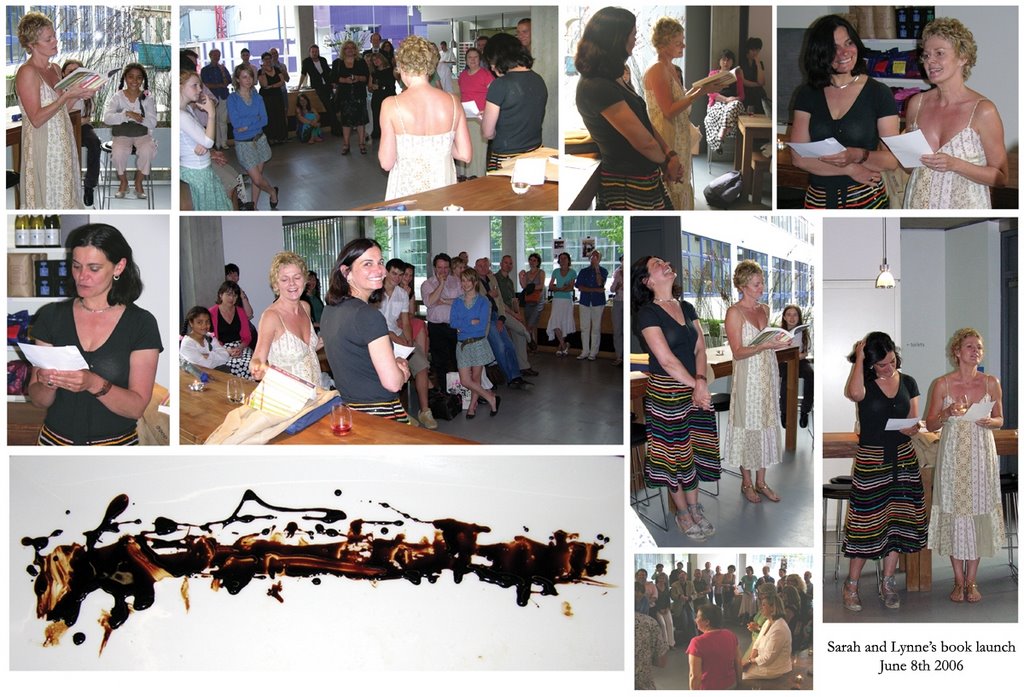 MESSAGES, Lynne Rees's and my new book of 300 pieces of 300 words, was launched in London last week. Published by Bluechrome, I do have to say the book is very very beautiful. Good party too - thanks to Tony for this collage!
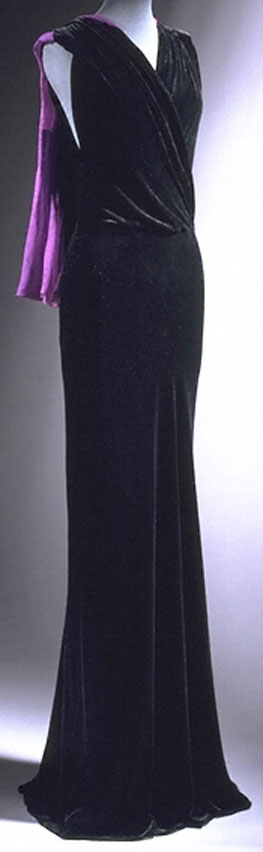 My writing prompt for today is to write about this beautiful dress by Madame Vionnet, sadly currently in the Victoria and Albert Museum and not in my wardrobe. The inspiration for this comes from the website's section on creative writing in galleries and museums - and in particular Michael Donaghy's poem here. The poem was written as part of a project which commissioned poets to pick a particular object from the museum and write a poem about it. I would have picked this dress I'm sure. When I was at Fashion College I picked Madame Vionnet as the subject for my final project, something that spoils you for Top Shop for ever more!
OK, let me come back to blogging-land with a bang. Here's the best extreme diet coke and mentos experiment I've seen, and it makes me laugh every time. Keep on watching - it gets worse! It's from Eepybird. Enjoy!
Friday, June 02, 2006
I don't know if it's the weather, my age or just a process I'm going through, but I'm turning down more than I'm accepting at the moment and just relishing being on my own. Even small things seem too much pressure and I've had all the challenges I can handle for the moment. Nothing makes me happier than an hour writing or reading, or best of all, digging on my allotment. The other day I even walked by a celebrity without noticing her because I was so interested in what my friend was telling me about the asparagus she's got growing in her garden - this is me, prime celebrity spotter! And although I do love London, I realise I'm putting off going there because it tires me out so much, and it's the opposite of that Samuel Johnson quote: 'When a man is tired of London, he's tired of life' in that I seem to be engaging with the smallest things in my life much more. I'm sure normal hectic service will be resumed soon, but in the meantime this poem by Thomas Hardy seemed appropriate!
A Private Man on Public Men
by Thomas Hardy
When my contemporaries were driving
Their coach through Life with strain and striving,
And raking riches into heaps,
And ably pleading in the Courts
With smart rejoinders and retorts,
Or where the Senate nightly keeps
Its vigils, till their fames were fanned
By rumour's tongue throughout the land,
I lived in quiet, screened, unknown,
Pondering upon some stick or stone,
Or news of some rare book or bird
Latterly bought, or seen, or heard,
Not wishing ever to set eyes on
The surging crowd beyond the horizon,
Tasting years of moderate gladness
Mellowed by sundry days of sadness,
Shut from the noise of the world without,
Hearing but dimly its rush and rout,
Unenvying those amid its roar,
Little endowed, not wanting more.
Thursday, June 01, 2006
I love this story from PN Online. It gives me hope, but I'm so jealous of the prize. Imagine having a pig named after your book!:
Unknown makes the Bollinger shortlist
WHILE THE SHORTLIST for this year’s Bollinger Everyman Wodehouse Prize for Comic Fiction is packed with famous writers – Terry Pratchett and Jilly Cooper among them – there is one author on the list who is a complete unknown. Robert Lewis, author of The Last Llanelli Train (Serpent’s Tail), is a 26-year-old first novelist whose debut title features a shambolic, alcoholic private eye.
Lewis may be young, but he’s already accumulated plenty of life experience. Originally from the Brecon Beacons, he describes himself as having been “a silver service waiter, painter, secretary, salesman, banker, web editor, yardcat [a form of night-watchman], high-voltage cabler, housing officer, mailboy, audit junior, welder’s assistant, and unemployed”. He’s now graduated from the University of Wales, Aberystwyth (where he now lives) as an English Literature mature student. His second book, Swansea Terminal, will be published next year, and he currently works as a journalist on trade paper In Business. “I made a new year’s resolution to stop working in accounts departments and that kind of thing,” he said.
Pete Ayrton, owner and MD of Serpent’s Tail, said: “It’s a darkly funny book. There’s a tradition in noir of gallows humour, and Robert Lewis has got that in trumps. It’s quite a feat to make what could be seen as a pretty depressing plot – the main character’s a complete failure – into something extremely funny.” The book was bought from Antony Topping at Greene & Heaton.
The other shortlisted titles are: Thud by Terry Pratchett and May Contain Nuts by John O’Farrell (both Doubleday); Wicked by Jilly Cooper (Bantam); All Fun and Games Until Somebody Loses an Eye (Abacus) by Christopher Brookmyre; and Zadie Smith’s On Beauty (Hamish Hamilton). The winner will be announced at the Hay Festival on 4 June, and will be given a jeroboam of Bollinger Special Cuvée, a case of Bollinger La Grande Année, and a Gloucestershire Old Spot pig named after the winning book.
Poetry Thursday!

I know this photograph is a little macabre, but two things have happened to me recently with birds, and I'm feeling fragile as I'm a great believer in signs! Yesterday, looking for tomato plants at a market garden I felt a strange blub on my head but couldn't see anything above me, although when I put my hand to my hair, yes, you've guessed it, a bird had pooped on me. It's never happened before, but my son said it was a good sign. Why, I asked. Well, apparently because it's so bad that nothing else can go quite so badly. Hmmmm, some logic there, I suppose. Secondly, and more disturbingly, I found this little bird foetus on the balcony outside my bedroom window this morning. No sign of a broken egg, nest or anything. It looks perfect but is big - about one and a half inches long - so I can't work out what it might be. It feels rather like the Great Bird Godfather has left me a 'message'.
So in an effort to appease the birds - who I love, by the way - here's a poem for Poetry Thursday from Emily Dickinson, and I'm just off to bury the little chap above in a tissue-lined matchbox as well as filling up the bird feeder in my garden.

I know this photograph is a little macabre, but two things have happened to me recently with birds, and I'm feeling fragile as I'm a great believer in signs! Yesterday, looking for tomato plants at a market garden I felt a strange blub on my head but couldn't see anything above me, although when I put my hand to my hair, yes, you've guessed it, a bird had pooped on me. It's never happened before, but my son said it was a good sign. Why, I asked. Well, apparently because it's so bad that nothing else can go quite so badly. Hmmmm, some logic there, I suppose. Secondly, and more disturbingly, I found this little bird foetus on the balcony outside my bedroom window this morning. No sign of a broken egg, nest or anything. It looks perfect but is big - about one and a half inches long - so I can't work out what it might be. It feels rather like the Great Bird Godfather has left me a 'message'.
So in an effort to appease the birds - who I love, by the way - here's a poem for Poetry Thursday from Emily Dickinson, and I'm just off to bury the little chap above in a tissue-lined matchbox as well as filling up the bird feeder in my garden.
I shall keep singing!
Emily Dickinson
I shall keep singing!
Birds will pass me
On their way to Yellower Climes—
Each—with a Robin's expectation—
I—with my Redbreast—
And my Rhymes—
Late—when I take my place in summer—
But—I shall bring a fuller tune—
Vespers—are sweeter than Matins-Signor—
Morning—only the seed of Noon—
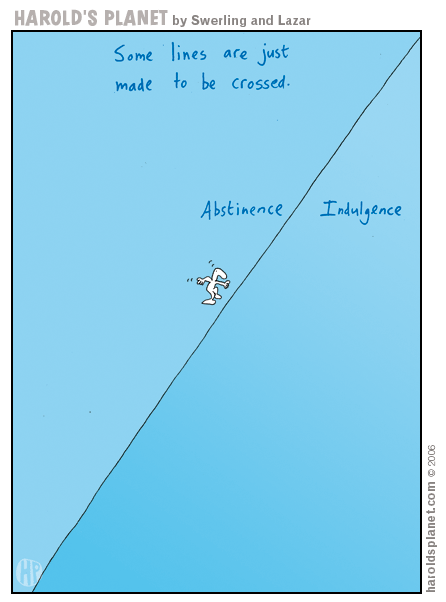

Subscribe to:
Posts (Atom)

This work by Sarah Salway is licensed under a Creative Commons Attribution-Noncommercial-Share Alike 3.0 Unported License.