Just have to share this quote. Best advice I've heard for a long time: “If you want your children to turn out well, spend twice as much time with them, and half as much money.”
—ABIGAIL VAN BUREN
Monday, February 06, 2006


USEFUL WRITING DISTRACTIONS - NUMBER THREE - TO-DO LISTS
If I tell you that I'm staring at a to-do list which contains, randomly: Wash Socks, Find trim for tiles, finish phd, commas - you'll probably be able to guage the chaos I'm currently living in! I need a certain space and order in which to write - mentally as well as physically, and writing to-do lists is something I turn to with a passion when I find my mind crammed with little voices telling me about all the important things I SHOULD be doing. Please note this is USEFUL writing distractions, not USELESS. I couldn't live without my lists!
One of my favourite teaching stories is Michele Roberts's Lists, which consists structurally of a woman's to-do lists in the run up to Christmas. From the expected - Order Turkey - we move to - Poison Husband - in that completely logical, although illogical, mix of great and small things that most of us put on our lists. This is something she captures perfectly, and adds another layer to the story as we are shown the movement in her heroine's mind. Plus the pleasure of ticking off the points. Oh, yes, that pleasure!
Another use of Christmas lists is in Maxine Hong Kingston's poem, which again catches the attempt to make order out of chaos. In the interview, she talks about the need 'not to get lost amongst the general uproar' in a way that resonates mightily. But as I'm writing this, one thing strikes me. I can't remember any such domestic list-making device in a male writer's work. Now, I wonder why that should be ....
If I tell you that I'm staring at a to-do list which contains, randomly: Wash Socks, Find trim for tiles, finish phd, commas - you'll probably be able to guage the chaos I'm currently living in! I need a certain space and order in which to write - mentally as well as physically, and writing to-do lists is something I turn to with a passion when I find my mind crammed with little voices telling me about all the important things I SHOULD be doing. Please note this is USEFUL writing distractions, not USELESS. I couldn't live without my lists!
One of my favourite teaching stories is Michele Roberts's Lists, which consists structurally of a woman's to-do lists in the run up to Christmas. From the expected - Order Turkey - we move to - Poison Husband - in that completely logical, although illogical, mix of great and small things that most of us put on our lists. This is something she captures perfectly, and adds another layer to the story as we are shown the movement in her heroine's mind. Plus the pleasure of ticking off the points. Oh, yes, that pleasure!
Another use of Christmas lists is in Maxine Hong Kingston's poem, which again catches the attempt to make order out of chaos. In the interview, she talks about the need 'not to get lost amongst the general uproar' in a way that resonates mightily. But as I'm writing this, one thing strikes me. I can't remember any such domestic list-making device in a male writer's work. Now, I wonder why that should be ....
Sunday, February 05, 2006
Got a prizewinning short story? Apparently the organisers of the V S Pritchett Memorial Prize are 'enthusiastically' seeking entries, and the closing date has been put back a week.
Finally, I'm putting the commas and last references into my PhD thesis, and waiting for my viva date. I have to be honest and say I never thought I'd get here, so it's sods law I've only just come across a site which would have been a godsend over the last two years. It would have been a great comfort to have realised there were so many other people struggling to 'Phinish' their PhD too!!!!
The thesis is on the storied self - and how we automatically make narrative patterns to cover the chaos we feel when we're without a story that makes sense of our lives. It's been fascinating applying it to the writing process, and how difficult it is just to let go and see what happens. Freewriting helps in this, but there's something else too. And that's trust. I'm coming to the conclusion that writers have to be so open to everything. The best quote I've found, and it's so beautiful I typed it up to have by my desk, is this one from Richard Kearney's book, On Stories.
He wrote: 'The novelist becomes someone who discloses rather than imposes, who listens gently when the city quietens and sleeps, so that he might 'hear the ghosts of stories whispered.' And at such times, the storyteller feels himself in the presence of something greater than himself'.
It makes me realise how often my writing has gone wrong when I've tried to 'impose' the story - either in plot, or in a message I want to get across. I like the fact, implicit in this quote, that we don't always have to invent the wheel. I'm reading Zadie Smith's On Beauty at the moment, and I love the fact she's following the tradition and route carved by another writer. In my mind, it adds to the complexity and layers of the writing.
The thesis is on the storied self - and how we automatically make narrative patterns to cover the chaos we feel when we're without a story that makes sense of our lives. It's been fascinating applying it to the writing process, and how difficult it is just to let go and see what happens. Freewriting helps in this, but there's something else too. And that's trust. I'm coming to the conclusion that writers have to be so open to everything. The best quote I've found, and it's so beautiful I typed it up to have by my desk, is this one from Richard Kearney's book, On Stories.
He wrote: 'The novelist becomes someone who discloses rather than imposes, who listens gently when the city quietens and sleeps, so that he might 'hear the ghosts of stories whispered.' And at such times, the storyteller feels himself in the presence of something greater than himself'.
It makes me realise how often my writing has gone wrong when I've tried to 'impose' the story - either in plot, or in a message I want to get across. I like the fact, implicit in this quote, that we don't always have to invent the wheel. I'm reading Zadie Smith's On Beauty at the moment, and I love the fact she's following the tradition and route carved by another writer. In my mind, it adds to the complexity and layers of the writing.
Saturday, February 04, 2006

Friday, February 03, 2006
Some great weekend reading newly put up on the British Council's New Writing website. I particularly enjoyed Helen Simpson's story and that wonderful description of a 'bluff new boyfriend'. Great word that, bluff. Somehow I imagine someone in the nude but all shiny!

A friend commented recently that I was obviously in touch with my inner-teenager these days (to which, of course, I replied 'you just don't understand me' and ran out of the room, slamming the door). But there are advantages. Over Christmas, my 19-year-old niece put some of her music on my ipod, including the wonderful Snow Patrol and since then I've been a woman obsessed. The songwriter, Gary Lightbody, is a poet, and is quoted as saying he never wants to write about the nice bits where the relationship starts, but the chaos at the end. Who hasn't identified at some time in their lives with the anquished end to the line, 'You've not heard a single word I have said... Oh my god!' Or indeed, 'I haven't made half the mistakes/that you've listed so far.'
Look at the words to Run for a better idea of what I mean. The lines above come from 'How to Be Dead'.
Which brings me to the song titles, and how often they don't seem to resemble in any way the song they're attached to. I keep listening to 'How To be Dead' in the hope I'll work out why it's called that. If you've an answer, please put me out of my misery. But my writing prompt for today is going to come from possibly the bizarrest song title ever: 'Get Balsamic Vinegar ... Quick You Fool'.
OK, gush over. I am aware that this is a case of skewed priorities to be writing about a band on a day that has been apparently declared: 'The International Day of Anger'. But I'm not the only one. On the radio news this morning, without a hint of irony, there was a report about how Prince Charles had addressed an audience of mutton lovers at a London hotel, saying it was a 'tragedy' that we didn't eat more mutton. A tragedy? Really? Perhaps it's time we reclaimed that word, particularly when looking more closely at what's going on in the world outside our comfortable lives.
Thursday, February 02, 2006
I'm sorry but am I missing something? Apparently David Cameron has been voted one of the 100 sexiest men. There are days when I think I don't belong in the world. Or, at least, not everyone else's world.
Yesterday was a BIG day, the one when I seriously got stuck back into novel 3, tentatively called The Seduction Committee. This is very important to me, as it now turns out that - for mostly good and wholly understandable reasons - Tell Me Everything won't come out in the UK bookshops until Spring 2007. This feels even more strange considering I've seen the cover and edited the page-proofs, making the book very real to me, at least - a ghost baby, as it were. I'm also conscious of people giving me little sideways looks when they ask me about it, as if they're wondering whether I really have written the book or not. So just to prove it, here's a preview of a final draft of the cover blurb.
Tell Me Everything
She didn’t mean to tell the story, or have it end that way. She just got a little . . . carried away.
It has been several years since she confided in her teacher, and Molly Drayton is still feeling the aftershocks. But when a chance meeting with a stranger leads to an offer of a room in exchange for telling stories, Molly jumps at the chance. Slowly she builds a new eccentric family: Tim, her secretive boyfriend, who just might be a spy; Miranda, the lovelorn hair stylist; Liz, the lusty librarian; Mr. Roberts, landlord and listener; and his wife, Mrs. Roberts, who is that very wonderful thing, French.
Much to Molly’s surprise, she finds the stories she tells now are her key to creating a completely different life. Suddenly her future is full of possibilities. The trouble is, Molly’s not the only one telling tales.
Sarah Salway’s witty, finely-tuned, and poignant novel is an utterly entrancing chronicle of an unique coming-of-age, one that captures the imagination as it explores what we reveal to others, how honest we are with ourselves, and the consequences of trying to bridge fact and fiction.
I'd recommend all writers write a short blurb about their story or novel in progress. It's good to have to concentrate on what the main points are. When Tell Me Everything was just in draft stages, I read with Mil Millington in Newcastle and we were asked what our next books were about. Mil gave a concise and funny description that immediately made me want to read his, while I blurted and burbled on about someone telling dirty stories up a ladder to a man who may, or may not, be a pervert, and in the meantime there's this guy she meets in the park who may, or may not, be a spy. When I came to a standstill, both Mil and Clare (the Chair of the session) were staring at me bewildered, as were half of the audience. 'Never mind,' said Mil, 'I'm sure it will be very good.' Luckily, we all laughed then, otherwise I might have cried.
The time difference between writing and publishing books gives another problem apart from the limbo waiting period, and that's how you have to talk about books you finished literally years ago. Human nature being what it is, however, what you want to talk about is the one you're writing now. Hurrah for the internet then - I've just heard that a horror story that I finished just a week ago will be published in an ezine next month. More details later, for now I've hardly time to breathe.
It's my first horror - and thanks are due to M E Ellis who encouraged me through her own disturbed and worrying writing to go ahead and JUST DO IT! Shell's a great writer - has her first novel coming out as an e-book soon, and as I've never managed to read an email of hers without either laughing out loud, or crying, I can't wait to read the novel. She has a talent for picking words that cause a response in the reader - yep, making you feel sick is one of her responses too.
And my prompt comes from one that Shell gave me - which is to use the word Perchance in your text. Harder than I thought it would be!
Tell Me Everything
She didn’t mean to tell the story, or have it end that way. She just got a little . . . carried away.
It has been several years since she confided in her teacher, and Molly Drayton is still feeling the aftershocks. But when a chance meeting with a stranger leads to an offer of a room in exchange for telling stories, Molly jumps at the chance. Slowly she builds a new eccentric family: Tim, her secretive boyfriend, who just might be a spy; Miranda, the lovelorn hair stylist; Liz, the lusty librarian; Mr. Roberts, landlord and listener; and his wife, Mrs. Roberts, who is that very wonderful thing, French.
Much to Molly’s surprise, she finds the stories she tells now are her key to creating a completely different life. Suddenly her future is full of possibilities. The trouble is, Molly’s not the only one telling tales.
Sarah Salway’s witty, finely-tuned, and poignant novel is an utterly entrancing chronicle of an unique coming-of-age, one that captures the imagination as it explores what we reveal to others, how honest we are with ourselves, and the consequences of trying to bridge fact and fiction.
I'd recommend all writers write a short blurb about their story or novel in progress. It's good to have to concentrate on what the main points are. When Tell Me Everything was just in draft stages, I read with Mil Millington in Newcastle and we were asked what our next books were about. Mil gave a concise and funny description that immediately made me want to read his, while I blurted and burbled on about someone telling dirty stories up a ladder to a man who may, or may not, be a pervert, and in the meantime there's this guy she meets in the park who may, or may not, be a spy. When I came to a standstill, both Mil and Clare (the Chair of the session) were staring at me bewildered, as were half of the audience. 'Never mind,' said Mil, 'I'm sure it will be very good.' Luckily, we all laughed then, otherwise I might have cried.
The time difference between writing and publishing books gives another problem apart from the limbo waiting period, and that's how you have to talk about books you finished literally years ago. Human nature being what it is, however, what you want to talk about is the one you're writing now. Hurrah for the internet then - I've just heard that a horror story that I finished just a week ago will be published in an ezine next month. More details later, for now I've hardly time to breathe.
It's my first horror - and thanks are due to M E Ellis who encouraged me through her own disturbed and worrying writing to go ahead and JUST DO IT! Shell's a great writer - has her first novel coming out as an e-book soon, and as I've never managed to read an email of hers without either laughing out loud, or crying, I can't wait to read the novel. She has a talent for picking words that cause a response in the reader - yep, making you feel sick is one of her responses too.
And my prompt comes from one that Shell gave me - which is to use the word Perchance in your text. Harder than I thought it would be!
Wednesday, February 01, 2006
Most of the blogs I've been enjoying recently have taken the form of confessions and shameful moments, so here's mine which is - and please don't all shout at me at once - I've never quite 'got' Richard Ford.
I've been told so often by writers I admire that he is their favourite writer, that I SHOULD get him, that his books are the ones they'd save from burning buidings, and I've tried. Oh, I've tried. But here's another shameful confession. I have always LOVED the interviews I've read of his. In terms of process, he's way up there at the top for me, so why couldn't I enjoy his fiction in the way other people so obviously could? In his Powells interview I found myself jotting down notes - how it takes three or four stories for him to get the 'shape' of the collection, that the themes other people see aren't that ones he does, that he prefers to read work that is 'stylized, highly contrived, full of artifice' but to write in as natural a way as possible. In his Identity Theory interview he comes across equally as honest and truth searching. I even like his photograph - how shameful is that!
So it was both a surprise and a relief recently to find, when I sat down to write a story that had been hiding in my head for months, that the inspiration came from a short story of Ford's, The Overreachers. I'm not copying it, and this isn't a confession of plagiarism, but I wanted to capture the mood of that hotel room, and the relationship, where everybody is pretending to be someone different from who they are and secretly scared that they're aiming too high. But there's something else Ford captures so beautifully as well, and that's the relief of being found out. Or the worse actually happening. I can't think of anyone writing about that secret desire so well.
It made me wonder all over again, whether I'd been trying too hard to 'get' Ford. At first, I was even annoyed to find that he had written the story I couldn't stop thinking about. OK - and here's the real shame - what if I was put off him by all the people telling me I HAD to like him? Could I really be that childish? I've concluded that yes, I can. There are some writers I want to be able to find for myself, because that makes them truly mine. But now I've stumbled across Richard Ford all by myself ... let me tell you this. You HAVE to read Richard Ford. You MUST save his books from burning buildings. Sooner or later, whether you like it or not, you will!
And my writing prompt comes loosely from Overreachers and is a wrong telephone number.
I've been told so often by writers I admire that he is their favourite writer, that I SHOULD get him, that his books are the ones they'd save from burning buidings, and I've tried. Oh, I've tried. But here's another shameful confession. I have always LOVED the interviews I've read of his. In terms of process, he's way up there at the top for me, so why couldn't I enjoy his fiction in the way other people so obviously could? In his Powells interview I found myself jotting down notes - how it takes three or four stories for him to get the 'shape' of the collection, that the themes other people see aren't that ones he does, that he prefers to read work that is 'stylized, highly contrived, full of artifice' but to write in as natural a way as possible. In his Identity Theory interview he comes across equally as honest and truth searching. I even like his photograph - how shameful is that!
So it was both a surprise and a relief recently to find, when I sat down to write a story that had been hiding in my head for months, that the inspiration came from a short story of Ford's, The Overreachers. I'm not copying it, and this isn't a confession of plagiarism, but I wanted to capture the mood of that hotel room, and the relationship, where everybody is pretending to be someone different from who they are and secretly scared that they're aiming too high. But there's something else Ford captures so beautifully as well, and that's the relief of being found out. Or the worse actually happening. I can't think of anyone writing about that secret desire so well.
It made me wonder all over again, whether I'd been trying too hard to 'get' Ford. At first, I was even annoyed to find that he had written the story I couldn't stop thinking about. OK - and here's the real shame - what if I was put off him by all the people telling me I HAD to like him? Could I really be that childish? I've concluded that yes, I can. There are some writers I want to be able to find for myself, because that makes them truly mine. But now I've stumbled across Richard Ford all by myself ... let me tell you this. You HAVE to read Richard Ford. You MUST save his books from burning buildings. Sooner or later, whether you like it or not, you will!
And my writing prompt comes loosely from Overreachers and is a wrong telephone number.
Tuesday, January 31, 2006
USEFUL WRITING DISTRACTIONS - NUMBER TWO - CHOOSING THE RIGHT MUSIC
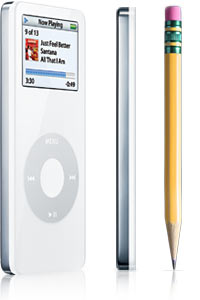
This beautiful thing was my best Christmas present. It really is that small, it fits in my hand perfectly, and has wasted many hours of my time already. The version of the Nano I have takes 500 songs - I thought that would be masses but already I'm up to nearly 400, so I've been organising them into playlists.
My favourite list is the one of songs about writing and/or books. So far I have a measley six - but I'm sure there are many more to collect:
Every day I write the book - Elvis Costello
Mr Writer - Stereophonics
Paperback Writer - The Beatles
The Book I haven't read - Lambchop
Sonnet - The Verve
Lady Writer - Dire Straits.
Any other suggestions?
Finding music I can write to is always hard. When I was writing Something Beginning With, I had such a clear narratorial voice in my head, but because editing was some months after the initial writing burst, I found it hard to get back to that particular rhythm. I struggled and struggled, until by chance I started playing the music I'd been listening to fairly obsessively during the time I'd been writing the book, and voila - I was immediately back there in Verity's head. The music? Bryan Ferry singing old ballads. Don't ask.
There's a beautiful site I found which combines Japanese music and storytelling, and that's Elizabeth Falconer's work. Definitely worth visiting. I particularly love the concept of storytelling being about generosity, trust, sharing and determination, and the koto has such an extraordinary, evocative sound. I don't know Elizabeth, but she has her own blog that I've been reading and finding inspiration from. It's almost illegal, this feeling you get of knowing people through their random jottings on the internet. Like stalking.
And my writing prompt for today comes from one of the reviews on the site above and it is 'a feather-light touch'.
Monday, January 30, 2006
USEFUL WRITING DISTRACTIONS - NUMBER ONE - JOURNALS
Not writing them, that actually helps your writing (see Jane Urquhart's wonderful pages of architectural drawings and notes) but choosing the perfect one that's going to allow you to write best-sellers for ever.
There are certain criteria it has to fill for me. It has to fit my hand, to be tactile, to have lined pages, a ribbon (oh, a ribbon) bookmark, and best of all one of those elastic band thingys that go round so I can swack it satisfactorily when I've finished my notes. Most of all though - it can't be too pretty or expensive. That just freezes me.
There are shelves of journals now in bookshops (will there be a time when there are more blank books than published novels for sale? Now that would be frightening!) - and also on the internet, which have been giving me hours of non-writing pleasure. I keep clicking on the palmistry one. Will that tell my fortune as well?
My writing prompt comes from a news story over the weekend that teenagers are using the word 'book' instead of 'cool' nowadays because it's the first choice of the predictive text on their mobile phones. I love that.
Sunday, January 29, 2006
A poem in progress... no prizes for guessing where the inspiration for this one came from!
FABULOUS BROADS
And they are. I can't stop looking.
One day soon, I'll walk over, zip
into a spare skin, pat the tight
leather gloss of it with my hard red
nails, water tight. I'll do the splits,
juggle flaming torches, walk right
up to the bar on my spiked heels,
order drinks I can't pronounce, fire
my throat and turn to him, ask
if his smile is for me, knowing it is,
and we'll leave, just a flounce of hair
instead of a backwards glance.
I'll know what to say, what to do,
and it WILL be fabulous. Apart, that is,
from those times I won't let him find
the zip, hoping he'll stop tapping, late
at night, trying to feel his way
past, looking too long. One day soon.
FABULOUS BROADS
And they are. I can't stop looking.
One day soon, I'll walk over, zip
into a spare skin, pat the tight
leather gloss of it with my hard red
nails, water tight. I'll do the splits,
juggle flaming torches, walk right
up to the bar on my spiked heels,
order drinks I can't pronounce, fire
my throat and turn to him, ask
if his smile is for me, knowing it is,
and we'll leave, just a flounce of hair
instead of a backwards glance.
I'll know what to say, what to do,
and it WILL be fabulous. Apart, that is,
from those times I won't let him find
the zip, hoping he'll stop tapping, late
at night, trying to feel his way
past, looking too long. One day soon.
There are so many websites, books, even tutors like me, who are dishing out writing tips left, right and centre. Here's one that got me excited this morning though. Not that there are 50 things you can do - that's rather overwhelming - but I just can't stop thinking about number 17, which is the act of putting two strange things beside each other to make a story. The writer uses the seduction of Emma Bovary at an agricultural fair, as an example, and it makes me think of a writing prompt that proved so successful there was a whole book written about it. So I'm going to use that particular prompt for writing today, and it is ... a wedding cake in the middle of the road.
Saturday, January 28, 2006
I have been thinking about getting older recently, not least because my friend Lynne gave me a Fabulous Broads calendar which I keep by my bed, and most of the quotes from it seems to be from - and about - older women. Not only that, I find I'm mentally saying them in a strange version of a Southern accent, starting and ending them with 'Honey', even though looking through that's never in any of the quotes. 'Honey, a salad is not a meal. It is a style, honey' (Fran Lebowitz). You get the picture.
There are many that make me laugh out loud, such as: 'If your house is really a mess and a stranger comes to the door, greet him with, 'Who could have done this? We have no enemies.' (Phyllis Diller). Others though make me smile and then feel bad, because the humour largely relies not just on being cruel to men, but on getting money or 'stuff' from them, and surely that's the antithesis of a fabulous woman? The women I want to admire aren't playing any kind of gender games. Honey, they just go out and buy diamonds for themselves, honey.
But then there are other quotes that bring me up short, and think 'yes, that's what I want to be like'. Here's one from Erica Jong: 'Do you want me to tell you something really subversive? Love is everything it's cracked up to be. That's why people are so cyncial about it. It really is worth fighting for, being brave for, risking everything for. And the trouble is, if you don't risk everything, you risk even more.' It sums up everything I've been thinking recently - that it's actually more of a risk, and harder, to trust. Cynicism is just the easy way out. Ho hum. I do have a sense of humour, really.
But... just before I 'here endeth the lesson', here's a real lesson in how a fabulous broad takes responsibility for herself, and what she thinks. This is Sharon Olds's open letter explaining why she wouldn't be attending last year's National Book Festival, also courtesy of Lynne. Seamus Heaney defined a writing voice as knowing your stance in life, and putting this into your words. It's interesting thinking about that and reading this letter, because I just know the person who wrote it is the same one who has written the poems in 'The Unswept Room', for instance, and I can respect that in a writer more than any technical excellence. So I guess my definition of a Fabulous Broad is someone who will always have things 'worth fighting for, being brave for, risking everything for,' and Sharon Olds is my 'Broad of the day'.
And my writing prompt is from Mrs Dalloway, and is 'She stood her upright, dusted her frock, kissed her.'
There are many that make me laugh out loud, such as: 'If your house is really a mess and a stranger comes to the door, greet him with, 'Who could have done this? We have no enemies.' (Phyllis Diller). Others though make me smile and then feel bad, because the humour largely relies not just on being cruel to men, but on getting money or 'stuff' from them, and surely that's the antithesis of a fabulous woman? The women I want to admire aren't playing any kind of gender games. Honey, they just go out and buy diamonds for themselves, honey.
But then there are other quotes that bring me up short, and think 'yes, that's what I want to be like'. Here's one from Erica Jong: 'Do you want me to tell you something really subversive? Love is everything it's cracked up to be. That's why people are so cyncial about it. It really is worth fighting for, being brave for, risking everything for. And the trouble is, if you don't risk everything, you risk even more.' It sums up everything I've been thinking recently - that it's actually more of a risk, and harder, to trust. Cynicism is just the easy way out. Ho hum. I do have a sense of humour, really.
But... just before I 'here endeth the lesson', here's a real lesson in how a fabulous broad takes responsibility for herself, and what she thinks. This is Sharon Olds's open letter explaining why she wouldn't be attending last year's National Book Festival, also courtesy of Lynne. Seamus Heaney defined a writing voice as knowing your stance in life, and putting this into your words. It's interesting thinking about that and reading this letter, because I just know the person who wrote it is the same one who has written the poems in 'The Unswept Room', for instance, and I can respect that in a writer more than any technical excellence. So I guess my definition of a Fabulous Broad is someone who will always have things 'worth fighting for, being brave for, risking everything for,' and Sharon Olds is my 'Broad of the day'.
And my writing prompt is from Mrs Dalloway, and is 'She stood her upright, dusted her frock, kissed her.'
Sunday, January 22, 2006
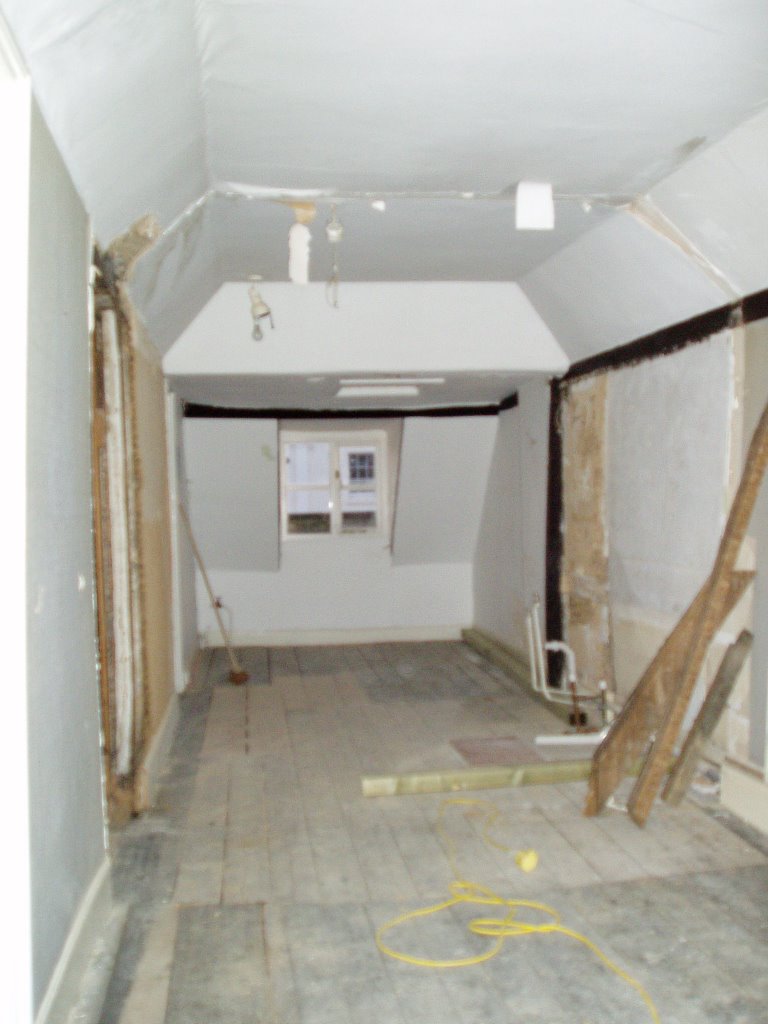

The building site on the right is my writing room at the moment, so it's probably not hard to understand why I'm a bit obsessed at where other people write. My ideal is to have a hut in the garden, like George Bernard Shaw's which actually rotates so that it's always in the sun, but the closest I'm likely to get is one of the huts in the allotments above!
I fancy the skinny tall one.
I was interested though to find this article about communal writing rooms in New York, and was feeling envious about it being only in America writers could find such spaces, when I came across some in London's Soho Theatre. Definitely worth a look, although I'm guessing you wouldn't be able to leave things a mess there. I identified completely with the story about Angela Carter in the National Gallery's Interrupted Lives book. Apparently when a photographer went to take her picture at work, he was horrified to find she'd spent days clearing up beforehand. The photographer, Mike Laye, commented "My assistant and I set to, emptying the waste-paper bin and scattering the contents over the floor, then adding books and records that had been nicely racked, into piles on the floor! She was pretty shocked at what we had done to her once-tidy study but did confirm that we had returned it to pretty much its usual state!"
In the meantime, it's just me and the builders making messes on our own. Expect lots of stories about strong tea and mobile phone tones - have never heard so many different ones. It's almost beautiful.
And my writing prompt for today is the parrot that gave the game away. Strictly fictional, of course.
Saturday, January 21, 2006
I am not sure whether it is a wise fable or a piece of surreal randomness, but I enjoyed Fernando Sorrentino's very short story, Essence and Attribute, this morning on the
Eastoftheweb site. This site is a useful pool of lots of classic and modern short stories too.
And, joy of joys, I found a site featuring poets reading their own work, including Elizabeth Bishop reading The Armadillo. Magic. Enjoy!
For my writing prompt this weekend, I'm going to use the photographs of Andy Goldsworthy's strange arch over a wall at Goodwood. I love the idea of something constructed to do nothing very much at all, except make you wonder!
Eastoftheweb site. This site is a useful pool of lots of classic and modern short stories too.
And, joy of joys, I found a site featuring poets reading their own work, including Elizabeth Bishop reading The Armadillo. Magic. Enjoy!
For my writing prompt this weekend, I'm going to use the photographs of Andy Goldsworthy's strange arch over a wall at Goodwood. I love the idea of something constructed to do nothing very much at all, except make you wonder!
Friday, January 20, 2006
Recently I drank a strange man's champagne from his fridge, ate his pasta and slept in his bed. And more than this, I've never even met him! Living in furnished rented accomodation is weird - I find I'm making up stories about my landlord from his choice of lamps, curtains, even - especially - pictures. I suppose the moral of this is never to rent your home out to a writer. I was excited though to find here a whole narrative being given to a sofa left in a skip. Makes me think about the stories we're making up everyday without even being aware of it.
Wednesday, January 18, 2006
I'm tired of shouting at British politicians on the radio who are sounding more and more alike, plus it's raining, so what better time to start my own revolution, to create my own world. I should be writing, but instead I'm going to spend some time planning who I want to run this. Kindness is going to be the most used word in our new language, people will be rewarded for their generosity to everyone, not just for talking louder than anyone else and/or bullying, and we'll all be allowed to progress at our own speed. In fact, we'll gain points for taking things a bit slower, and be rewarded by packs of glitter, coloured pens and sticky things. No, have not gone mad - I do know I'm sounding like I want everything to be a giant Liberty's department store, where my friend swears they put soporophic drugs in the potpourri so no one complains at how long it takes to buy anything (if you can afford it), and that's not reality, but, oh but. Good game here anyway.
The best book I've read on female utopia's is Herland by Charlotte Perkins Gilman - you can read it on the Project Gutenberg site for free.
And my mission for today is to learn how to do links in these posts, and my writing prompt comes from Carol Ann Duffy's TS Eliot Award Winning collection, Rapture - and is 'the answers I don't know by heart, yet'.
The best book I've read on female utopia's is Herland by Charlotte Perkins Gilman - you can read it on the Project Gutenberg site for free.
And my mission for today is to learn how to do links in these posts, and my writing prompt comes from Carol Ann Duffy's TS Eliot Award Winning collection, Rapture - and is 'the answers I don't know by heart, yet'.
Monday, January 16, 2006
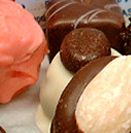
In London's Marylebone Road, there's one of the best chocolate shops in the world. Rococo. It's a tiny little jewel of a shop - almost like a boutique of the senses, and there are chocolates shaped like tiny vegetables, eggs, nipples, lips ... anything you can imagine. It's breath-takingly expensive, but even the packaging is beautiful, picturing blue and white fish, and boxes that you want to keep for special things. Trouble is I've just found out they have a website, and I've just been seduced, no other word for it, into ordering myself a box of their famous venus nipples. I'm going to use them as inspiration, I tell myself, for writing this erotic story I'm determined to finish this year. Wonder if I can write them off against tax! But all is not lost ... I'm going to confess on this great feature on the site, which asks for your chocolate confessions and awards a box of their best chocolates to the best one!
Watch this space...
Subscribe to:
Posts (Atom)

This work by Sarah Salway is licensed under a Creative Commons Attribution-Noncommercial-Share Alike 3.0 Unported License.